
Packaging is the complete system used to contain, protect, preserve, identify, transport and present a product. It includes the immediate container, closures, labels, inserts, cartons, shipping cases and unit-load materials, as well as the work required to design, fill, test and recover them. In practical terms, packaging is what allows a product to move from production to the customer in safe, usable conditions.
A package may be as simple as a paper sleeve or as complex as a sterilized multilayer medical pack inside a labeled carton and validated shipping case. The right design begins with the product and its distribution hazards, not with a favorite box style or material.
The short answer
- Primary packaging forms the sales unit or first enclosure around the product; it often touches the product, but function—not contact alone—defines the level.
- Secondary packaging groups, protects or displays primary packs.
- Tertiary packaging makes bulk storage and transport possible.
- Materials and formats are selected by product risk, shelf life, logistics, regulation, user needs and end-of-life reality.
Packaging at a glance
| Question | Short answer |
| What does packaging do? | It contains, protects, preserves, informs, enables use, supports logistics and presents the product. |
| What are the three packaging levels? | Primary packaging forms the sales unit or first enclosure; secondary packaging groups or presents sales units; tertiary packaging supports bulk handling and transport. |
| What materials are used? | Paper and board, plastics, glass, metal, wood, molded fiber, textiles and multi-material structures. |
| How is the right option chosen? | By matching product risks, shelf life, distribution, filling process, user needs, regulation, cost and realistic end-of-life routes. |
Packaging and packing are related but different
Packaging usually refers to the designed container or system that becomes part of the product offer, such as a bottle, carton, pouch, insert or shipping case. Packing is the operational act of placing goods into those components for storage or shipment. A business may design packaging once but pack thousands of orders every day.
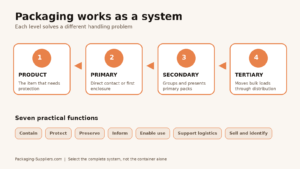
The main functions of packaging:
1. Contain the product
Containment keeps liquids, powders, loose components and counted units together. A bottle contains shampoo, a pouch contains coffee and a tray keeps a set of parts organized. The package must remain closed under the temperatures, pressures and handling forces it is expected to encounter.
2. Protect against damage
Packaging can resist impact, vibration, compression, abrasion, puncture, dust, moisture, oxygen, light, electrostatic discharge or microbial entry. Not every product needs every barrier. Fragile glassware may need cushioning and separation; roasted coffee needs strong oxygen and moisture control; a metal component may mainly need corrosion and surface protection.
3. Preserve quality and shelf life
Food, pharmaceuticals, cosmetics and other sensitive goods can deteriorate through oxygen, moisture, light, temperature or contamination. Barrier layers, tight seals, modified atmospheres, desiccants and light-blocking containers may slow that change. Shelf life should be supported by testing for the actual product-package combination rather than assumed from the material alone.
4. Communicate information
The package carries product identity, quantity, ingredients, directions, warnings, lot codes, dates, barcodes, traceability data and disposal guidance. Some information is legally required. The exact obligation depends on the product and the market in which it is sold, so artwork approval must include a regulatory review.
5. Make handling and use easier
Good packaging fits filling equipment, stacks efficiently, opens without unreasonable effort, dispenses cleanly and can be reclosed when the product requires it. Handles, tear notches, measuring caps, tamper evidence and child-resistant features are functional decisions rather than decoration.
6. Support logistics
Dimensions affect case packing, pallet pattern, trailer utilization, warehouse space and parcel charges. Strong packaging can reduce product damage, but excessive material and empty space add cost. The goal is enough verified performance with efficient material use and cube utilization.
7. Identify and sell the product
Structure, print, color and finish help shoppers recognize a product and compare options. Retail packaging must also work on a shelf or display, while e-commerce packaging may prioritize shipping protection, opening experience and returnability. Marketing cannot compensate for a package that leaks, crushes or confuses the user.
Primary, secondary and tertiary packaging
For the functional definitions and examples, see Primary, Secondary and Tertiary Packaging Explained.
| Level | Role | Examples |
| Primary | Creates the sales unit / first enclosure; often direct contact | Bottle, can, blister, pouch, jar, tube or inner wrap |
| Secondary | Groups one or more primary packs and may provide retail presentation | Folding carton, multipack sleeve, display tray or case |
| Tertiary | Combines units for storage, handling and transport | Corrugated shipper, pallet, stretch wrap, straps and corner boards |
These levels describe position in a packaging system, not a specific material. Stretch film can be primary when it directly wraps a product, secondary when it bundles retail units, or tertiary when it stabilizes a pallet. A corrugated box can be a consumer pack, a secondary case or a tertiary shipping container depending on the application.
One product can use all three levels
Consider a glass bottle of sauce sold in a supermarket. The bottle, cap and label form the primary pack. Twelve bottles may be separated by corrugated partitions inside a printed case, which acts as secondary packaging. Cases are then stacked on a pallet and secured with stretch film and corner boards for transport; together these components form the tertiary pack. If one level fails, the others may not compensate. A strong pallet load cannot prevent leakage from a poor closure, and a premium bottle cannot survive freight if the case and pallet pattern are under-designed.
Types of packaging by physical format
1. Rigid packaging
Rigid formats largely retain their shape when empty. Examples include glass jars, metal cans, plastic bottles, drums, wooden crates and rigid setup boxes. They can offer strong stacking, dimensional stability and barrier performance, but often use more material and transport volume than flexible formats.
2. Semi-rigid packaging
Semi-rigid packs hold a defined form but can flex under load. Folding cartons, thermoformed trays, tubs and many molded-fiber packs fit this group. They balance shape, presentation and material efficiency.
3. Flexible packaging
Bags, films, sachets, wraps and pouches conform around their contents. Flexible structures can use little material and ship efficiently, while high-barrier versions may combine several layers. That combination can improve performance but complicate collection and material recovery.
Common packaging materials
For a deeper comparison of barrier, strength, weight, cost and recovery tradeoffs, see our guide to types of packaging materials.
| Material family | Useful properties | Typical formats |
| Paper, paperboard and corrugated | Printable, foldable, stiff or cushioned depending on structure | Cartons, bags, sleeves, wraps, corrugated cases and displays |
| Plastics | Lightweight, sealable and available across a wide barrier and stiffness range | Bottles, tubs, caps, trays, films and pouches |
| Glass | Strong gas and moisture barrier, clarity and chemical resistance | Jars, bottles, vials and ampoules |
| Metal | High barrier, strength and heat tolerance | Cans, tins, tubes, drums, closures and aerosols |
| Wood | High load capacity and repairability | Pallets, crates, cases and specialty presentation packs |
| Molded fiber | Cushioning, nesting and fiber-based recovery potential | Trays, clamshells, cup carriers and protective inserts |
| Multi-material structures | Properties can be tailored by combining layers | Aseptic cartons, barrier pouches and lidded trays |
Where packaging is used
Food and beverage packaging manages hygiene, barrier needs, sealing and shelf life. Pharmaceutical and medical packaging adds demanding controls for compatibility, sterility, tamper evidence, dosing and traceability. Cosmetics often combine chemical compatibility with premium presentation. Industrial packaging emphasizes load restraint, corrosion prevention and safe handling. E-commerce packaging must survive parcel networks with repeated drops, vibration and compression. Retail-ready packaging must protect the product while opening quickly into an effective display.
The use environment changes the design
The same product may need a different package for store shelves, direct-to-consumer delivery or export. Retail packaging must face forward, carry required information and fit shelving. Parcel packaging experiences repeated drops, vibration, automated sortation and contact with other parcels. Export packaging may spend longer in storage, encounter higher humidity and require stronger palletization or legally compliant wood treatment. Packaging should therefore be specified for a known route, not for an abstract idea of “normal shipping.”
How packaging is developed
- Define the product: dimensions, mass, fragility, physical state, sensitivity, shelf life and hazardous characteristics.
- Map the complete journey: filling, storage, temperature, handling, parcel or freight distribution, retail and returns.
- List performance requirements: barrier, seal strength, compression, impact, cleanliness, accessibility and tamper evidence.
- Screen materials and formats for compatibility with the product and packing line.
- Develop prototypes and confirm manufacturability, tolerances, print and packing speed.
- Test the complete packed system using methods that represent the expected hazards.
- Confirm labeling, food-contact, dangerous-goods and market-specific requirements.
- Review total cost, including damage, labor, storage, transport, tooling and waste.
- Verify disposal, recycling, composting or reuse claims against real collection and processing routes.
See the current ISTA test-procedure library.
What makes packaging sustainable
Sustainable packaging is not defined by one material or one symbol. A credible design uses the minimum material needed for verified product protection, avoids unnecessary components, considers recycled or responsibly sourced content, improves transport efficiency and has an end-of-life route that customers can actually access. Preventing product loss also matters because a lightweight package that causes spoilage or breakage may increase the total environmental burden.
Environmental claims should state the material, conditions and geographic limits. “Recyclable” should not be used as a synonym for technically capable of being recycled. Collection, sorting and reprocessing availability determine whether the claim is meaningful in a particular market. For the claim distinctions, see Recyclable vs Biodegradable vs Compostable Packaging.
For U.S. environmental marketing, the FTC Green Guides say recyclable claims should be qualified when access to appropriate recycling facilities is limited. FTC Green Guides summary.
A better sustainability hierarchy
- Prevent product loss. Spoilage, breakage and returns can outweigh small material savings.
- Remove packaging that serves no protective, regulatory or user function.
- Right-size the remaining system and improve pallet or parcel efficiency.
- Prefer structures compatible with the collection and recovery systems in the sales market.
- Substantiate recycled-content, reusable, recyclable and compostable claims with evidence and conditions.
This order matters. Replacing a proven pack with a lighter option is not an improvement if damage, leakage or food waste rises. The package and product should be assessed as one system.
How to choose packaging for a product
Start with the most expensive failure. If leakage creates safety and recall risk, closure integrity comes first. If breakage is the main risk, study shock and vibration. If stale flavor limits shelf life, quantify oxygen and moisture barrier needs. If parcel charges dominate cost, right-size the pack and validate that the lighter design still protects the item.
- Choose by measured requirement instead of broad labels such as premium, eco-friendly or heavy duty.
- Test the filled package, because the contents, headspace and closure change performance.
- Evaluate the complete system, including inserts, labels, adhesives, tapes, coatings and tertiary packaging.
- Ask suppliers for tolerances, test data, material declarations, lead times, tooling ownership and change-control procedures.
Questions to answer before requesting a quote
- What are the product dimensions, filled weight and acceptable orientation?
- Which failures matter most: leakage, breakage, crushing, oxidation, moisture gain, contamination or theft?
- Will the pack be filled manually or on an existing line, and at what speed?
- Will it travel by parcel, palletized freight, air or ocean, and for how long?
- What print, label, traceability, tamper-evidence or accessibility features are required?
- What minimum order, lead time, storage space and landed-cost target apply?
A useful supplier brief includes these answers plus samples or drawings. “I need a sustainable box” is too broad to price or engineer responsibly.
Need packaging built to a controlled specification?
Packaging Suppliers is a global custom packaging solutions company that manages the complete packaging process—from design and prototyping to manufacturing, quality control, sourcing, and delivery—through a network of production facilities. For each quote, the production route can be confirmed before approval. Request a quote with your product, dimensions, quantity and performance needs; ask for a physical sample when fit, print or material needs to be approved.
Frequently asked questions
What is packaging in simple words?
Packaging is the container and protective system used to hold a product, keep it safe, communicate information and make transport, sale and use practical.
What are the three main levels of packaging?
They are primary, secondary and tertiary packaging. Primary packaging forms the sales unit or first enclosure around the product; secondary packaging groups or presents sales units; tertiary packaging supports bulk handling, storage and transport.
What are the most common packaging materials?
Paper and board, plastic, glass and metal are the most common broad families. Wood, molded fiber, textiles and multi-material laminates are also widely used.
What is the main purpose of packaging?
Its first purpose is to deliver the product in usable condition. Containment, protection, preservation, information, convenience, logistics and presentation support that goal.
Is all packaging recyclable?
No. Recyclability depends on construction, contamination, collection, sorting and available reprocessing markets. Multi-material structures and some small or flexible formats can be difficult to recover.
What is the difference between a package and packaging?
A package is one completed unit, such as a filled bottle or packed box. Packaging is the broader system of components and processes used to create, protect and distribute that unit.
Sources and standards
References used in the article: