
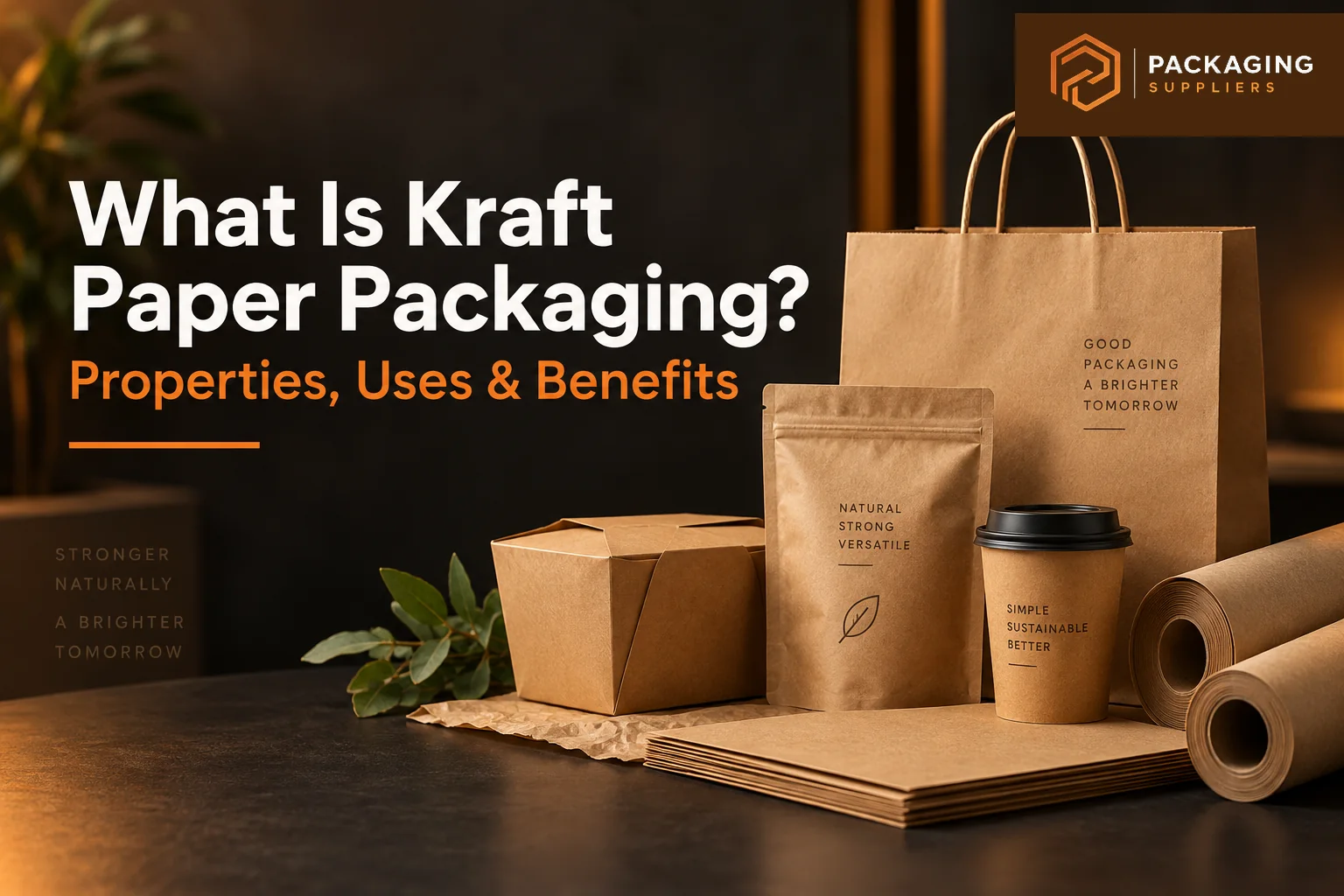
Kraft paper packaging uses strong paper or paperboard made wholly or partly from kraft (sulfate) pulp. It is commonly supplied as rolls, sheets, bags, sacks, wraps, liners, void fill, labels and converted paper structures. Natural kraft is usually brown, while bleached kraft can be white; coatings, laminations, sizing and recycled fiber can change both appearance and performance.
The important point is that “kraft” describes a paper-making route or fiber furnish, not a finished-package performance level. Two kraft papers can have very different grammage, tear strength, porosity, surface finish, wet strength and barrier properties. For procurement, specify the properties the product needs rather than asking only for “brown kraft paper.”
For the broader material landscape, see our guide to types of packaging materials.
Kraft paper at a glance
| Question | Short answer |
| What is it? | Paper or board made from kraft-process pulp, often selected for strength and toughness. |
| Is kraft always brown? | No. Natural/unbleached kraft is brown; bleached kraft grades are white. |
| Is kraft waterproof? | No. Untreated kraft absorbs water; sizing, coatings or laminations are needed where liquid or vapor resistance matters. |
| Is kraft the same as corrugated? | No. Kraft is a paper/fiber grade; corrugated is a multi-layer structure made from liners and fluted medium. Kraft linerboard can be one component of corrugated board. |
| Common uses | Bags, sacks, wraps, interleaving, void fill, envelopes, labels, tapes, food-service papers and corrugated liners. |
How kraft paper is made
In kraft pulping, wood chips are chemically treated to separate cellulose fibers from much of the lignin that binds them. The process preserves fiber strength well, which is why kraft pulp is widely used where tensile, tear and burst performance matter. The pulp can be used unbleached for a natural brown sheet or bleached when a white surface and brighter graphics are required.
After pulping, papermaking variables such as fiber mix, refining, basis weight, machine direction, surface sizing, calendering and moisture affect the final sheet. Converters may then print, coat, laminate, wax, crease, slit, glue or form the paper into a packaging format. Each conversion step can improve one property while changing another, so the finished structure—not the word “kraft”—should be validated.
Key properties of kraft paper packaging
1. Tensile and tear strength
Kraft fibers are valued for toughness, but strength is directional. Machine-direction tensile strength, cross-direction tear, elongation and puncture behavior can differ. A sack that must survive filling and pallet handling needs a different property balance from a decorative retail wrap.
2. Grammage and thickness
Grammage is mass per unit area, normally expressed in g/m². U.S. buyers also commonly see kraft paper sold by basis weight in pounds. TAPPI T 410 explains that U.S. basis weight is a pounds-per-ream convention tied to a defined basis size, so a “40 lb kraft” specification is not complete unless the applicable basis-size convention is understood. For packaging papers using a 3,000 ft² basis, 40 lb is about 65 g/m², but always confirm the supplier’s stated basis before converting. Thickness (caliper) is a separate property, and a higher basis weight or GSM does not automatically guarantee better tear, fold or wet performance.
3. Porosity and air flow
Porosity matters in high-speed filling and sack applications because trapped air may need to escape. A paper can be strong yet poorly suited to a filling line if its air permeability, venting pattern or ply construction is wrong for the powder or granule being packed.
3. Water and grease resistance
Untreated kraft is hygroscopic and can lose stiffness or strength as moisture rises. The Cobb test is commonly used to measure water absorptiveness; the current international method is ISO 535:2023. Grease resistance is also not inherent to ordinary kraft paper: food or oily products may require a functional coating, treatment or separate barrier layer.
4. Printability and appearance
Natural brown kraft supports a deliberately earthy visual style, but the brown substrate changes ink color and contrast. White or bleached kraft, coated grades or an opaque white ink can be used when accurate brand colors and fine graphics are more important. Surface smoothness and printing method should be approved with a production sample.
Common types and grades of kraft paper
| Grade / description | Typical characteristics | Common packaging uses |
| Natural / unbleached kraft | Brown appearance, strong fiber furnish, available in many grammages and finishes | Wraps, bags, interleaving, void fill, industrial papers |
| Bleached kraft | White appearance with strength and improved graphic contrast | Premium wraps, labels, food and retail applications where whiteness matters |
| Sack kraft | Engineered for high tensile, tear and elongation; often porous for filling performance | Multiwall sacks for powders, ingredients, chemicals and building materials |
| Machine-glazed (MG) kraft | One smoother/glossier side and one rougher side | Bags, wraps, release/interleaving and printed papers |
| Wet-strength kraft | Additives improve retained strength in damp or wet conditions | Moist environments, certain food, horticultural or industrial uses |
| Coated / laminated kraft | Barrier or surface layer added for grease, moisture, heat-seal or appearance | Food wraps, pouches, protective papers and specialty packs |
Commercial grade names vary by mill, region and converter. A purchasing specification should therefore include measurable properties and approved samples instead of relying only on a trade label.
Where kraft paper packaging is used
- Retail and grocery bags where flexibility, printability and tear resistance are needed.
- Multiwall industrial sacks for cement, flour, sugar, animal feed, chemicals and other dry products.
- Wrapping and interleaving for metal parts, furniture, textiles, glassware and manufactured components.
- Void fill and crumpled cushioning for e-commerce parcels where the product hazard is moderate.
- Food-service wraps and bags when the exact paper, coating, ink and adhesive system is suitable for the intended contact conditions.
- Labels, paper tapes, sleeves and protective surface papers.
- Linerboard and specialty containerboard used as flat facings in corrugated structures.
Benefits of kraft paper packaging
1. High strength for its mass
Well-specified kraft paper can provide useful tensile and tear performance at relatively low mass, which is why it works well for bags, sacks and wraps. The benefit is application-specific: structural stacking strength still requires a package geometry such as corrugated board, a rigid container or an engineered multi-ply sack.
2. Flexible converting and storage
Rolls and flat sheets store compactly, and paper can be slit, folded, crumpled, coated, printed or converted on high-speed equipment. This makes kraft useful as a component inside a larger packaging system as well as a standalone bag or wrap.
3. Strong brand and tactile potential
Natural kraft gives a recognizably fibrous, low-gloss look, while bleached and coated versions support more controlled graphics. Because appearance is tied to the grade and finish, brands should approve color on the actual stock rather than on a white-screen proof.
4. Established paper recovery systems—but not automatic recyclability
Paper recovery is well established in the U.S.; AF&PA reported a 2025 U.S. paper recycling rate of 61–65%. AF&PA 2025 recycling rates A national rate does not prove that every kraft package is recyclable, because coatings, laminations, adhesives, wet-strength chemistry, residue and local program rules can change the outcome.
Limitations and watch-outs
- Untreated kraft is not a high oxygen, water-vapor or liquid barrier.
- Humidity and direct wetting can reduce dimensional stability and strength.
- Brown stock changes print color, fine detail and barcode contrast.
- A thin paper wrap does not replace the compression and cushioning of a structural shipper.
- Coatings that solve grease, heat-seal or moisture problems can change repulpability and recycling claims.
- “Kraft,” “recycled,” “compostable” and “food safe” are separate attributes; one does not prove the others.
Food-contact and regulated applications
For direct food contact, the complete material system matters: paper furnish, coatings, inks, adhesives, additives and intended temperature/contact time. In the United States, food-contact substances are regulated by the FDA under their intended conditions of use. See the FDA food ingredients and packaging resources for the relevant compliance framework. A generic statement such as “kraft paper is food grade” is not enough without documentation for the exact construction.
Is kraft paper packaging sustainable?
Kraft can be a practical fiber-based option, but sustainability should be evaluated at the package-system level. Fiber source, recycled content, material mass, coatings, product protection, transport efficiency and end-of-life infrastructure all matter. A lighter wrap that causes damage or spoilage can perform worse overall than a slightly heavier structure that protects the product reliably.
Avoid broad claims such as “100% eco-friendly.” The FTC Green Guides advise marketers to qualify environmental claims and to avoid broad, unqualified general environmental-benefit claims. Recyclable claims should reflect real access to suitable recycling facilities and the complete finished package.
How to specify kraft paper packaging
- Define the product: dimensions, mass, surface sensitivity, moisture/oil content and any food-contact or regulatory requirement.
- Choose the package function: wrapping, bagging, sack, void fill, interleaving, liner, label or barrier component.
- Set measurable paper requirements: U.S. basis weight (lb) and/or GSM, caliper, tensile, tear, burst, elongation, porosity, Cobb value or other relevant properties.
- Specify the surface and print: natural or bleached shade, smoothness, coating, ink system, barcode and rub resistance.
- Define environmental exposure: humidity, condensation, freezing, heat, outdoor handling and storage time.
- Confirm converting needs: crease, fold, glue, heat seal, sewing, valve formation, perforation or automated filling.
- Validate the finished pack with the actual product and distribution route rather than testing paper properties alone.
- Obtain declarations for food contact, recycled content, fiber sourcing and environmental claims where those statements will be made.
Kraft paper vs corrugated packaging
Kraft paper and corrugated board are not equivalent categories. Kraft is a paper/fiber grade; corrugated is a structural construction. Use kraft paper when flexibility, wrapping, bagging or light protective separation is needed. Use corrugated when the package must form a rigid case, carry stacking load, provide flute cushioning or survive parcel/freight hazards.
For a requirements-based comparison, read Kraft Paper vs Corrugated Packaging.
Kraft paper packaging from Packaging Suppliers
Packaging Suppliers provides kraft paper packaging across a range of formats supported by our production capabilities. For specialized converting or finishing requirements, we can also coordinate with approved production partners.
To get an accurate quote, send us your packaging format, dimensions, quantity, basis weight (lb and/or GSM), printing requirements, finish, and any grease- or moisture-resistance needs. Our team will review your specifications and recommend the appropriate material and production options.
Ready to get started? Request a quote with your specifications and required quantity. If you’re unsure about any details, send us what you have and our packaging team can help finalize the requirements. You can also request a sample to evaluate the paper feel, print quality, color, and finish before production.
Frequently asked questions
Is kraft paper the same as brown paper?
Not always. Natural kraft is commonly brown, but brown appearance alone does not prove that a paper is made from kraft-process pulp. Bleached kraft can also be white.
Is kraft paper waterproof?
No. Ordinary kraft paper absorbs moisture. Sizing, coatings or laminations can improve liquid or vapor resistance, but those layers become part of the packaging specification and may affect recycling.
What GSM is best for kraft packaging?
There is no universal best grammage. The right GSM depends on whether the paper is used for wrapping, a bag, a sack, void fill, a liner or another structure, and on the required tear, tensile, barrier and converting performance.
Can kraft paper be used for food packaging?
Yes, when the exact paper, coating, ink, adhesive and intended conditions of use meet the relevant food-contact requirements. “Kraft” by itself is not a food-safety certification.
Is kraft paper recyclable?
Many clean, uncoated paper formats are compatible with paper-recycling systems, but acceptance depends on the finished package, coatings, laminates, adhesives, residue and local collection rules.
What is the difference between kraft paper and kraft linerboard?
Kraft paper is a broad paper category. Kraft linerboard is a heavier containerboard grade used as a flat facing in corrugated fiberboard.
Sources and standards
References used in the article: