
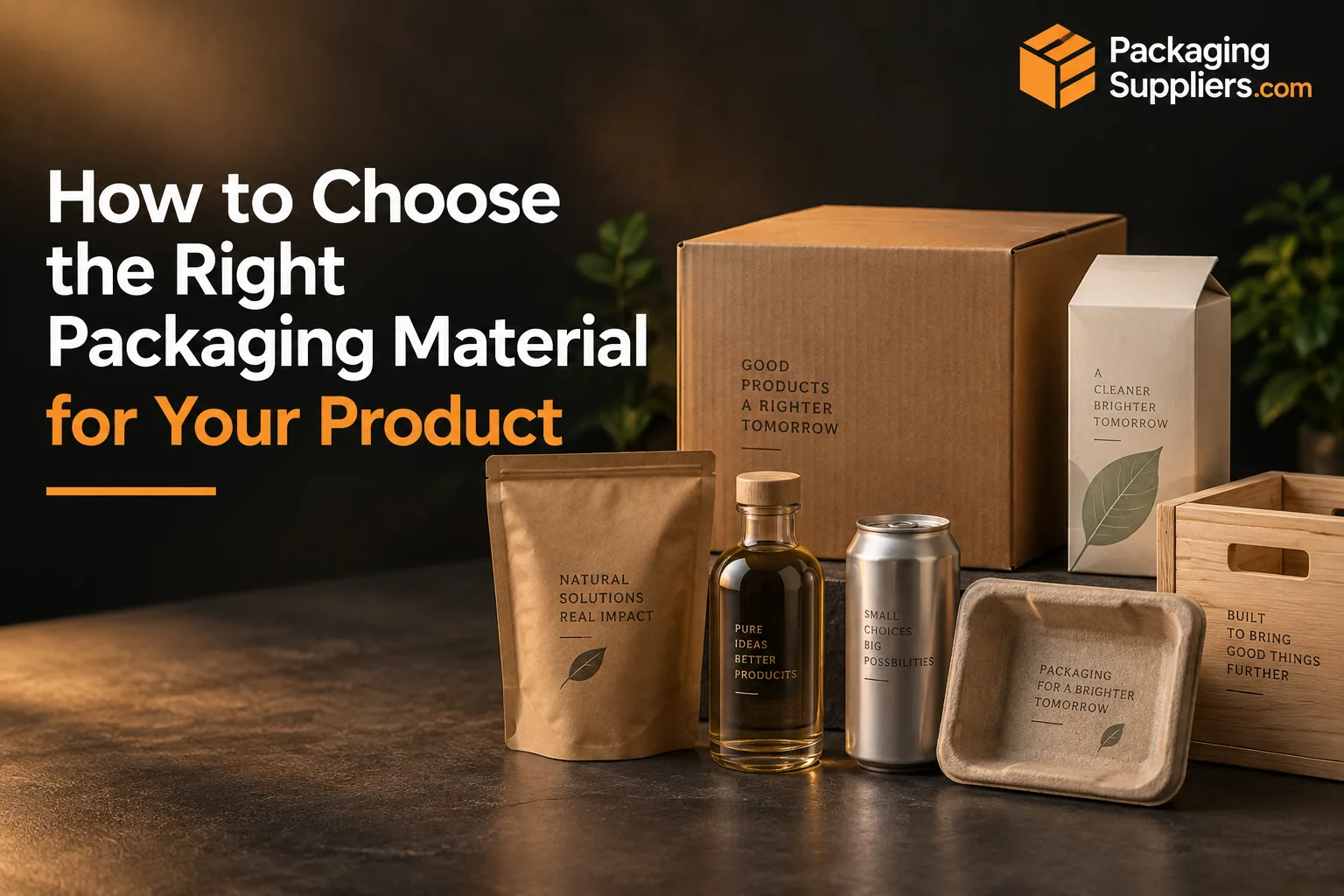
Choose packaging material by starting with the product and the failure you must prevent. Define what the pack has to contain, protect, preserve, survive, communicate and enable; then convert those needs into measurable barrier, strength, temperature, sealing, regulatory and usability requirements. Only after that should you compare paper, corrugated, plastics, glass, metal, wood, molded fiber or multilayer structures.
The right material is the one that meets the required performance, production and compliance conditions with acceptable cost and recovery options. A coffee pouch, glass sauce jar, pharmaceutical blister and industrial corrugated case solve different risks, so material selection should begin with the failure mode rather than a preferred substrate.
If you need a material-by-material primer first, read Types of Packaging Materials.
Start with the most expensive or dangerous failure
Material selection becomes easier when the problem is framed as failure prevention. If leakage could trigger a recall, seal and closure integrity dominate. If breakage creates returns, shock and compression dominate. If flavor staling limits shelf life, oxygen and moisture barrier dominate. If the package runs on an existing line, machinability may eliminate otherwise attractive materials immediately.
| Primary risk | Packaging requirement to define | Typical evidence |
| Breakage/crushing | Impact resistance, cushioning, compression and restraint | Drop, vibration, compression and transit testing |
| Oxidation/aroma loss | Oxygen barrier and seal integrity | OTR data, package leak/seal tests and shelf-life study |
| Moisture gain/loss | Water-vapor barrier | WVTR data and product stability testing |
| Leakage | Chemical compatibility, closure/seal strength | Leak, burst, torque or seal-strength testing |
| Light sensitivity | Visible/UV light barrier | Light transmission and product stability testing |
| Corrosion/interaction | Chemical compatibility and headspace control | Compatibility, migration or corrosion study |
| Stacking damage | Board/container compression and unit-load design | BCT/compression and pallet testing |
| Temperature/process failure | Thermal resistance and dimensional stability | Hot-fill, retort, freeze/thaw or thermal-cycle validation |
1. Define the product before the package
- Physical state: liquid, powder, solid, paste, aerosol or multi-component kit.
- Dimensions, filled mass, center of gravity and fragility.
- Oil, fat, alcohol, acid, solvent, aroma or active ingredients that may interact with the pack.
- Target shelf life and sensitivity to oxygen, moisture, light, contamination or temperature.
- Whether the product is dangerous, sterile, food-contact, pharmaceutical, cosmetic or otherwise regulated.
- How the consumer stores, opens, doses, recloses and disposes of the pack.
2. Define barrier requirements
Barrier is not a single property. Oxygen transmission, water-vapor transmission, light transmission, grease resistance and aroma retention address different degradation mechanisms. A paperboard carton may provide excellent print and stiffness but little inherent oxygen barrier; a glass jar may provide an excellent passive barrier but still depend on the closure liner for package integrity; a flexible pouch may need multiple layers so each layer performs a different function.
Where shelf life matters, use measurable targets and the actual package geometry. A supplier datasheet for flat film does not replace testing of the formed pouch, bottle, closure or filled pack because seals, folds, pinholes, headspace and fitments can become the weak point.
3. Match physical strength to the distribution route
A retail pack that moves in full pallets faces different hazards from a direct-to-consumer parcel. Map compression, vibration, drops, puncture, abrasion, pallet overhang, long warehouse dwell, cold-chain condensation and return shipping. The primary package and shipping case should be designed together rather than optimized independently.
For shipping systems, ASTM D4169-23e1 provides a framework for evaluating shipping units using test sequences representative of distribution hazards. The exact program should match the expected route and risk level.
4. Check filling, sealing and manufacturing compatibility
A material that protects the product on paper can still fail commercially if it cannot run on the line. Confirm filling temperature, line speed, heat-seal range, capping torque, vacuum, pressure, sterilization, die-cutting, gluing, coding, labeling, metal detection and inspection needs. Also confirm tolerances that affect automated handling, such as bottle neck finish, pouch width, carton score position and corrugated dimensions.
5. Confirm product-contact and regulatory suitability
For U.S. food packaging, the FDA explains that food-contact substances and components must be authorized for their intended use when required, and the relevant conditions include food type, temperature and contact conditions. A supplier should provide documentation for the exact resin, coating, ink, adhesive or other component system being supplied.
Do not treat a generic statement such as “food safe,” “pharma grade” or “BPA-free” as a complete compliance specification. Define the market, intended use and evidence required by your regulatory and quality teams.
6. Screen the material families
| Material family | Useful strengths | Common watch-outs | Typical starting uses |
| Paper / paperboard | Printability, stiffness, folding, low mass | Moisture/grease sensitivity unless treated; coatings alter recovery | Cartons, sleeves, bags, labels |
| Corrugated fiberboard | Stiffness-to-weight, cushioning, stacking, custom structures | Humidity and box geometry affect compression | Shipping cases, mailers, displays, inserts |
| Rigid plastic | Low mass, toughness, moldability, closures, clarity options | Permeation, stress cracking, resin/recovery differences | Bottles, jars, tubs, trays, caps |
| Flexible films/laminates | Very low mass, sealability, tailored barrier, full-surface print | Puncture and some multilayer recovery limitations | Pouches, sachets, wraps, lidding |
| Glass | Excellent gas/moisture barrier, clarity, chemical inertness | Weight, breakage, thermal shock | Food, beverage, cosmetics, pharma |
| Metal | High light/gas/moisture barrier, heat tolerance, strength | Denting, coatings, tooling/volume economics | Cans, tins, tubes, drums, closures |
| Wood | High load capacity, repairability and rigidity | Weight, moisture/pests, export treatment requirements | Pallets, crates, heavy equipment |
| Molded fiber | Cushioning, nesting, fiber-based presentation | Moisture/grease performance and dimensional tolerance vary | Trays, inserts, food-service packs |
7. Choose rigid, semi-rigid or flexible format
Material and format are separate decisions. PET can become a rigid bottle or a thin film layer; paper fibers can become a flexible bag, folding carton, molded-fiber tray or corrugated shipping case. Decide how much inherent shape, dispensing, puncture resistance, collapse behavior and transport efficiency the package needs.
See Rigid vs Flexible Packaging for a format-level comparison.
8. Evaluate user experience and branding after the protection brief
Opening, dosing, reclose, child resistance, tamper evidence, accessibility, grip, storage footprint and disposal instructions are functional requirements. Print, color, texture, transparency and finishing matter too, but brand presentation should be built on a structure that already protects the product and runs reliably.
9. Evaluate sustainability at system level
Do not select a material solely because it is paper, plastic, recycled, biobased or compostable. A credible comparison includes product protection, material mass, recycled or responsibly sourced content, transport efficiency, reuse where practical, and whether the package can enter a collection and processing system in the market where it is sold.
The FTC Green Guides caution against broad unqualified “green” claims and explain that recyclable/compostable claims can require qualification based on actual access to appropriate facilities. ISO 18601 and ISO 18602 provide packaging-and-environment frameworks for general requirements and optimization of packaging systems.
10. Compare total cost and supply risk
Price per empty package is only one cost. Include tooling, print setup, closures, labels, inserts, packing labor, scrap, line speed, freight, storage, damage, returns, obsolete inventory and supplier minimums. Also check lead time, raw-material availability, change-control practice, alternate-source strategy and how quickly the specification can be replenished.
Worked selection examples
Roasted coffee beans
Primary risks are oxygen, moisture and aroma loss. A flexible high-barrier pouch with a strong seal and, where needed, a degassing valve may be efficient. The correct laminate depends on shelf life, roast behavior, filling process and recovery strategy; “kraft pouch” appearance alone does not establish barrier performance.
Glass sauce jars sold through e-commerce
The primary glass jar may be ideal for product compatibility and shelf appeal, but parcel distribution introduces breakage risk. Corrugated partitions, cushioning, controlled headspace and tested outer cases may matter more than changing the primary container.
Premium skincare product
The formula may require an airless dispenser, opaque protection or compatibility with oils/actives. A rigid bottle or jar can support premium presentation and precision dispensing, but the pump, gasket, liner and decoration must be tested as part of the product-contact system.
Industrial machined part
Corrosion, abrasion, weight and handling may dominate. A combination of corrosion-control wrap or bag, protective foam/fiber inserts, corrugated or wood outer packaging and pallet restraint can be more appropriate than asking for one “best material.”
A supplier-ready packaging material brief
| Input | What to provide |
| Product | Composition, physical state, dimensions, filled weight, fragility and compatibility concerns |
| Shelf life | Target duration and sensitivity to oxygen, moisture, light, aroma or contamination |
| Process | Fill temperature, sealing/capping, sterilization, line speed and inspection |
| Distribution | Parcel/freight/pallet, route length, stacking, humidity, cold chain and returns |
| User | Opening, reclose, dispensing, accessibility, tamper evidence and storage after opening |
| Commercial | Order quantity, annual volume, launch date, target cost and warehouse constraints |
| Brand | Print process, colors, finish, window/clarity and labeling space |
| Compliance | Destination markets, food contact or other regulatory documents, testing and claim evidence |
Common material-selection mistakes
- Starting with “I want kraft/plastic/glass” before defining the required performance.
- Assuming a material name proves food-contact suitability, barrier or recyclability.
- Specifying only GSM, thickness or resin family without the functional tests that matter.
- Testing the empty package rather than the filled product-package system.
- Ignoring packaging-line compatibility until after artwork or tooling is approved.
- Optimizing primary packaging while creating more damage, secondary packaging or freight elsewhere in the system.
- Comparing quotes that use different materials, tolerances, print assumptions or freight terms.
Turn the material decision into a quote-ready specification
Packaging Suppliers manufactures packaging across formats supported by our production capabilities. When a project requires specialized materials, converting, or production processes outside our in-house scope, we can coordinate with approved production partners.
Once the material direction is established, turn it into a production-ready brief. Define the product being packed, dimensions or capacity, order quantity, filling process, material or performance requirements, barrier needs, closure system, printing and finishing specifications, and expected storage, handling, and shipping conditions. These details help determine the appropriate material construction and production route.
Ready for a packaging quote? Send us your product details, dimensions, quantity, filling method, shipping route, material preferences, performance requirements, and artwork or existing specifications if available. If some technical details are still undecided, share what you have and our packaging team can help identify the remaining requirements. Request a sample or prototype when fit, barrier performance, closure, print quality, or handling needs physical approval before production.
Frequently asked questions
What is the best packaging material?
There is no universal best material. The best option is the one that meets the product’s protection, process, user, regulatory, logistics and end-of-life requirements at an acceptable total cost. For claim terminology, see Recyclable vs Biodegradable vs Compostable Packaging.
How do I choose packaging for a fragile product?
Define the expected drops, vibration, compression and handling route; then design restraint and cushioning around the product. Corrugated, molded fiber, foam or other protective systems may be combined with the primary pack.
What packaging is best for moisture-sensitive products?
Use a structure with a verified water-vapor barrier and reliable seals. The answer may be a coated paper, rigid container or flexible laminate depending on the product and process.
Is paper packaging always more sustainable than plastic?
No. Material mass, product protection, transport, recycled content, recovery and local infrastructure all matter. Compare the complete system instead of using material category as a sustainability shortcut.
What should I test before approving packaging?
Test the properties tied to the main failure risks: seals/leaks, barrier, compatibility, drop/vibration, compression, temperature, closure and user performance. Use production-representative materials and the actual product.
When should I involve a packaging supplier?
Early enough that material, tooling, print, line compatibility and lead time can be considered before the design is locked. A clear product and distribution brief makes supplier input much more useful.
Sources and standards
References used in the article: