
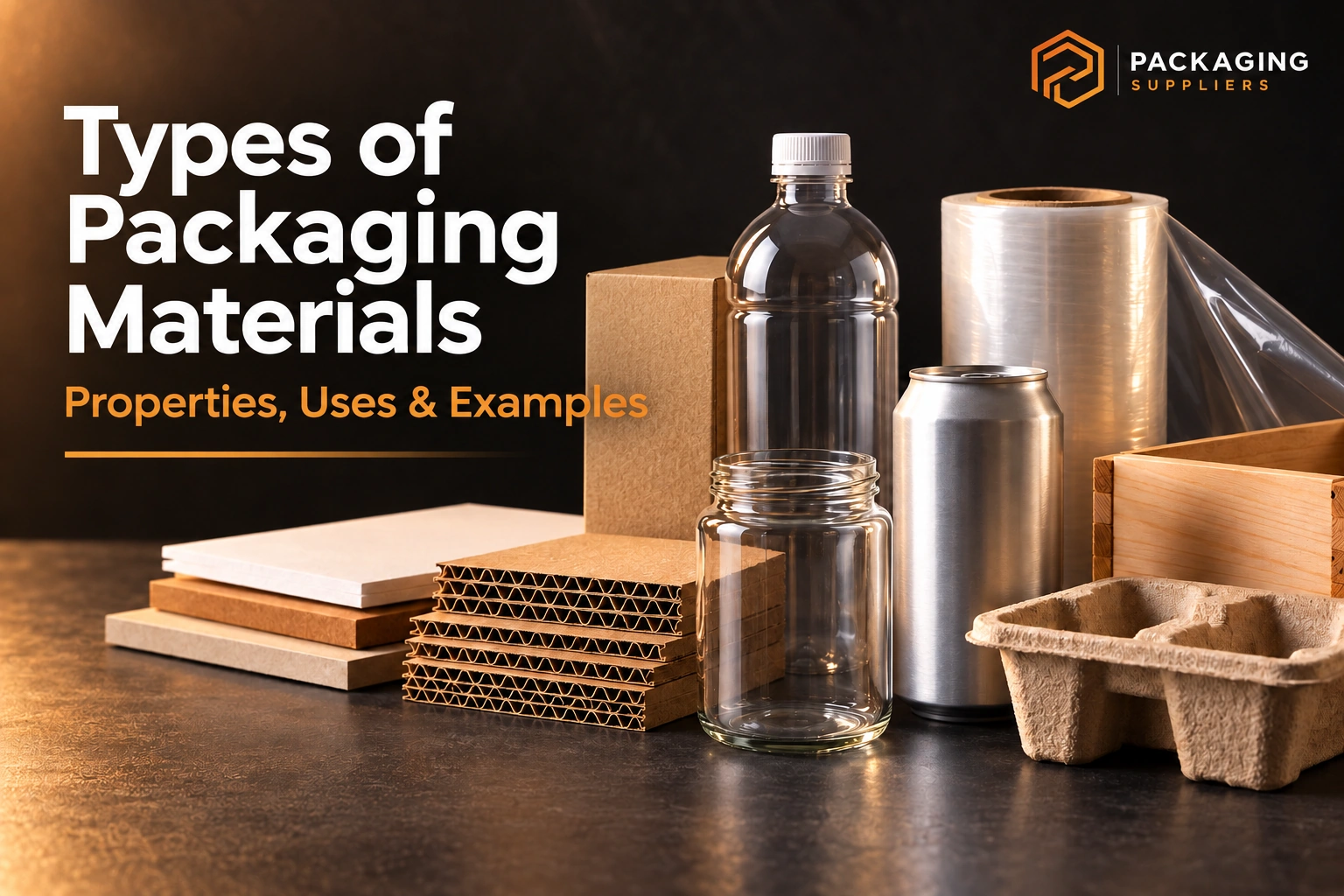
The main packaging materials are paper and paperboard, corrugated fiberboard, plastics, glass, metals, wood, molded fiber, foams, textiles and multi-material laminates. They are not interchangeable: each provides a different combination of strength, stiffness, cushioning, sealability, oxygen and moisture barrier, temperature resistance, weight, printability and recovery options.
No material is automatically best. A dry retail product may need a printable folding carton, a carbonated drink may need a pressure-resistant bottle or can, and a moisture-sensitive food may require a sealed high-barrier structure. Selection should start with measurable product and supply-chain requirements.
For the broader framework of packaging levels, functions and formats, start with what packaging is.
Quick selection guide
- Choose paperboard when print quality, folding and shelf presentation matter more than high barrier.
- Choose corrugated when shipping strength, stacking and cushioning are the priority.
- Choose plastic when low weight, sealability, toughness or a tailored barrier is required.
- Choose glass when chemical resistance, product visibility and an excellent passive barrier justify the extra weight and break risk.
- Choose metal when the product needs a strong, hermetic, light-blocking container or heat processing.
- Use a laminate only when one material cannot meet the verified performance requirement.
Packaging material comparison
| Material | Strength and barrier profile | Weight, cost & recovery | Typical uses |
| Paper and paperboard | Good stiffness and print surface; untreated grades have limited moisture and grease resistance | Low weight. Cost varies by grade, print and coatings. Clean compatible fiber is commonly recovered; heavy coatings or food soil can limit acceptance. | Cartons, sleeves, bags and labels |
| Corrugated fiberboard | High stiffness-to-weight ratio and cushioning; barrier depends on liners and coatings | Low to medium weight. Cost depends on board grade, print, tooling and volume. Widely recovered where clean; waxes/coatings can change recovery. | Shipping cases, displays and protective inserts |
| Plastic | Properties vary widely; can be rigid or flexible and heat-sealable | Very low to medium weight. Resin, tooling and converting drive cost. Recovery varies strongly by resin, color, format, size and local systems. | Bottles, tubs, films, pouches and closures |
| Glass | Excellent gas and moisture barrier with chemical inertness | High weight. Freight, breakage control and handling add system cost. Recyclability depends on local glass collection and color/format acceptance. | Food, beverage, cosmetic and pharmaceutical containers |
| Metal | Excellent light, gas and moisture barrier; strong and heat tolerant | Medium weight. Material and forming economics often favor volume. Steel and aluminum are widely recyclable where collection and sorting exist. | Cans, tins, aerosols, drums and closures |
| Wood | High load-bearing capacity and repairability | High weight. Lumber, fabrication and export treatment can add cost. Pallets/crates may be repairable or reusable; recovery is market-specific. | Pallets, crates, cases and luxury boxes |
| Molded fiber | Good cushioning and nesting; limited barrier unless treated | Low weight. Tooling and volume influence cost. Fiber recovery or composting depends on formulation, coatings, food soil and local acceptance. | Trays, inserts and food-service packs |
| Laminates | Barrier and mechanical properties tailored by layer | Low weight. Extra layers and converting add complexity. Inseparable multi-material structures can be difficult to sort and reprocess. | Aseptic, retort and high-barrier flexible packs |
Paper and paperboard
Paper-based packaging covers lightweight papers, thicker paperboard and converted structures such as bags, wraps, folding cartons, tubes and sleeves. Cellulose fibers create a surface that accepts print and can be scored, folded, glued, embossed or coated. Paperboard grades are commonly selected for stiffness, caliper, surface finish, cleanliness and converting performance.
Best uses
- Folding cartons for food, pharmaceuticals, cosmetics and consumer goods
- Kraft paper bags, wraps and void fill
- Solid bleached or coated boards for high-quality graphics
- Chipboard or recycled board for set-up boxes, partitions and backing cards
- Paper labels, sleeves and tamper-evident bands
Limitations
Untreated fiber absorbs moisture and oils and loses strength when wet. Coatings, waxes, polymer layers or aluminum may improve barrier performance, but the finished structure must be assessed as a whole because added layers can affect repulpability, food-contact suitability and recovery.
Corrugated fiberboard
Corrugated board combines one or more fluted paper media with flat linerboards. The arches create spacing and directional stiffness, giving the board high strength for its mass. Single-wall board is common for shipping cases; double-wall and triple-wall constructions add stiffness and protection for demanding loads. Flute profile, paper weights, board grade, box dimensions and joint design all influence performance.
For wall constructions, flute profiles, ECT, burst and box compression, read the full corrugated packaging guide.
Best uses
- Parcel and freight shipping cases
- Retail-ready and point-of-purchase displays
- Protective pads, partitions and die-cut inserts
- Produce trays and bulk bins
- Printed e-commerce mailers
Limitations
Humidity, sustained stacking load, hand holes, ventilation openings, poor pallet overhang and weak box geometry can reduce compression performance. A board grade alone does not guarantee that a finished case will protect a specific product.
Plastic packaging
Plastic is a broad family rather than one material. Polyethylene can provide flexibility and moisture resistance; polypropylene offers stiffness and useful heat performance; PET is used for clear bottles, trays and films; polystyrene appears in rigid and foamed formats; polyamide and EVOH may be used as functional barrier layers. Additives, colorants, coatings and orientation further change performance.
Common packaging polymers
- LDPE and LLDPE: flexible films, liners and sealant layers where toughness and moisture resistance are useful.
- HDPE: bottles, jugs, drums and closures requiring stiffness and impact resistance.
- PP: tubs, caps, trays and films requiring stiffness, fatigue resistance or higher service temperatures.
- PET: clear beverage bottles, jars, trays and films requiring clarity and useful gas-barrier performance.
- PA or nylon: puncture-resistant layers in vacuum and high-performance flexible structures.
- EVOH: a thin oxygen-barrier layer protected by moisture-resistant polymers in coextruded structures.
Resin identification codes identify the broad resin family; they do not guarantee curbside acceptance. Color, labels, closures, adhesives, fillers, multilayer construction, size and local sorting capability all affect recovery.
Rigid plastic
Bottles, jars, tubs, trays, caps and closures can be injection molded, blow molded or thermoformed. Rigid plastics are light and resistant to breakage, but compatibility with the product, filling temperature, pressure, stress cracking and permeation must be checked.
Flexible plastic
Films can be formed into bags, sachets, lidding and stand-up pouches. They use little material and can provide tight seals, but small-format films and multi-layer structures may not fit local curbside recycling systems.
Glass packaging
Glass is chemically stable and provides an excellent barrier to gases and moisture. It can communicate quality through clarity, color, shape and weight and can tolerate hot filling or thermal processing when the container is designed for it.
Best uses
- Beverages, sauces, preserves and baby food
- Fragrances and premium cosmetics
- Pharmaceutical bottles, vials and ampoules
- Products whose flavor or formulation requires an inert contact surface
Limitations
Glass is heavy and brittle. Impact, thermal shock, internal pressure and defects must be controlled. Secondary packaging often needs partitions, sleeves or cushioning, and transport emissions can be influenced by container mass and distance.
Metal packaging
Steel and aluminum provide excellent barriers to light, oxygen and moisture. Metal can withstand retorting and high-speed filling, and thin walls create strong, stackable containers. Common formats include beverage and food cans, tins, aerosol containers, foil, tubes, drums and closures.
Aluminum and steel serve different roles
Aluminum is light, corrosion resistant and readily formed into beverage cans, trays, foil and collapsible tubes. Steel offers high strength and magnetic separation advantages and is widely used for food cans, pails and industrial containers. For either material, the internal coating, seam, closure and processing conditions are part of the package specification; “metal” alone does not establish compatibility or shelf life.
Limitations
Products may require internal coatings to prevent corrosion or interaction. Denting, seam quality, pressure and opening safety matter. Tooling and production economics often favor higher volumes, although stock components can reduce the entry threshold.
Wood packaging
Pallets, crates, skids and cases carry heavy or irregular equipment and can be repaired or reused. Wood also appears in premium presentation packaging. Export shipments may be subject to phytosanitary controls; ISPM 15 establishes treatment and marking requirements for regulated wood packaging material used in international trade. IPPC ISPM standards
Molded fiber packaging
Molded pulp uses fiber slurry formed and dried into trays, clamshells and inserts. It can cushion products, nest efficiently and replace some foam or plastic components. Surface quality, tolerances, moisture response, grease resistance and tooling depend on the process and formulation.
Foams, cushioning and textile materials
Expanded polystyrene, polyethylene and polyurethane foams are used when precise cushioning, thermal insulation or repeated impact protection is needed. Paper cushioning, air pillows and molded fiber may be alternatives in some applications. Textile bags and woven polypropylene sacks serve agricultural, industrial and reusable applications. Selection should consider dust, abrasion, static, moisture, recovery and reuse.
Multi-material and coated structures
A single layer rarely provides stiffness, sealability, puncture resistance, printability and strong oxygen, moisture and light barriers at once. Laminates combine materials so each layer performs a specific job. A typical pouch might use an outer printable film, a barrier layer and an inner heat-seal layer. Aseptic cartons combine paper-based structure with polymer and, in some designs, aluminum barrier.
These structures can protect food and reduce product waste, but inseparable layers may be difficult to recycle in systems designed for single-material packs. Design decisions must balance product protection with collection and reprocessing reality.
Bioplastics are not one end-of-life category
“Bio-based” describes feedstock origin, while “biodegradable” and “compostable” describe behavior under stated conditions. A bio-based plastic may be chemically identical to a conventional polymer and recyclable in the same stream; another may require an industrial composting facility. In the U.S., ASTM D6400-26 is the active specification for labeling plastics designed to compost in municipal or industrial aerobic composting facilities. Claims should name the relevant standard, conditions and collection route; facility-compostable packaging should not be presented as likely to disappear safely in soil, water or ordinary litter. ASTM D6400-26 For a U.S.-focused claim comparison, see Recyclable vs Biodegradable vs Compostable Packaging.
Properties that matter when comparing materials
| Property | Why it matters | How it is expressed or checked |
| Compression and stiffness | Stacking, pallet loads and shape retention | Board tests, container tests and full-box compression |
| Impact and cushioning | Drops, vibration and fragile products | Drop testing, vibration testing and cushion curves |
| Oxygen barrier | Flavor, oxidation and shelf life | Oxygen transmission rate |
| Moisture barrier | Crispness, dry products and corrosion | Water-vapor transmission rate |
| Seal performance | Leak prevention and package integrity | Seal strength, burst, leak and dye tests |
| Chemical compatibility | Prevents swelling, corrosion, migration or flavor change | Compatibility and migration studies |
| Temperature resistance | Filling, freezing, retort and distribution extremes | Conditioning and thermal-cycle testing |
| Print and decoration | Brand, instructions and traceability | Ink adhesion, rub and barcode verification |
Food contact and regulated products
A material that is acceptable for one application is not automatically suitable for direct food, pharmaceutical or cosmetic contact. In the United States, FDA requirements for food-contact substances depend on the exact substance and its intended conditions of use. Suppliers should provide declarations, specifications and supporting compliance information for the exact resin, coating, ink, adhesive and colorant system. FDA food-contact conditions of use
Migration and product compatibility
Packaging can interact with its contents in both directions. Substances may migrate from the pack into a product, while flavors, oils, solvents or active ingredients may be absorbed into the material or attack coatings, seals and adhesives. Evaluation may include overall or specific migration, extractables and leachables, flavor scalping, stress cracking, corrosion, light transmission and shelf-life testing. The correct program depends on the product, contact time, temperature and target market.
Recyclable does not describe the material alone
Recovery depends on the complete package, including size, color, labels, closures, coatings, adhesives, product residue and local infrastructure. A mono-material design may improve compatibility, but businesses should confirm accepted formats in the target market. Reusable formats also need a return system, enough rotations and cleaning controls to deliver their intended benefit. FTC recyclable-claim guidance
A practical material selection process
- Define the product hazards and required shelf life.
- Identify filling, sealing, sterilization and packing-line conditions.
- Map distribution hazards and storage climate.
- Set measurable barrier, strength, dimensional and usability requirements.
- Screen candidate material and format combinations.
- Prototype with production-representative materials.
- Test the filled package and complete shipping configuration.
- Confirm regulatory documents and environmental claim evidence.
- Compare total system cost rather than price per empty unit.
Compare total system cost, not price per unit
A lower unit price can be misleading if the material slows the packing line, needs more warehouse space, increases parcel weight, requires extra cushioning or causes more damage. Compare tooling, minimum orders, scrap, labor, storage, transport, product loss, returns and end-of-life obligations. The best material is the one that meets the requirement at the lowest defensible total cost and environmental burden.
A worked example
A business shipping a 250 ml cosmetic serum might first consider a glass bottle for product compatibility and premium presentation. The distribution review then identifies parcel breakage risk, so the complete solution may include a molded-fiber insert and corrugated mailer. Alternatively, a compatible PET bottle could reduce mass and breakage but change the barrier, feel and recycling route. The decision cannot be made by comparing glass and plastic in isolation; it requires shelf-life, drop, leakage, user and recovery evidence for the finished pack.
Turn material requirements into a production-ready package
Packaging Suppliers is a manufactures packaging in the product lines handled by our own production and can use approved production partners for specialized formats outside that scope. Start with the barrier, strength, contact, print and recovery requirements rather than a material label alone. Request a quote for the finished specification, and request a sample when the construction needs physical validation.
Conclusion
Packaging materials are engineering choices with different strengths and tradeoffs. Paper and board provide printability and structure, plastics provide light weight and tunable performance, glass and metal provide strong barriers, wood carries heavy loads, and molded fiber supplies shaped cushioning. The best specification is the one that protects the real product through its real journey with documented compliance and a credible end-of-life plan.
Frequently asked questions
What are the five most common packaging materials?
Paper and paperboard, plastic, glass, metal and wood are five widely used families. Corrugated fiberboard and molded fiber are often discussed separately because their structures and applications are distinctive.
Which packaging material is strongest?
Strength depends on the load and failure mode. Metal and wood carry demanding loads, corrugated board offers excellent strength for its weight, and engineered plastics can provide impact resistance. The finished package must be tested.
Which material has the best barrier?
Glass and metal provide very strong barriers to gases and moisture when their closures and seams are sound. Plastic and paper structures can reach specific barrier targets through resin choice, coatings or laminates.
What is the lightest packaging material?
Thin flexible films usually use very little mass, but a lower package weight does not automatically mean lower total impact if protection, recovery or product waste performs poorly.
Is paper packaging always recyclable?
No. Clean, compatible paper and board are commonly recovered, but wet strength additives, heavy coatings, food residue and bonded non-paper layers can affect acceptance and processing.
How should a business compare packaging materials?
Compare the complete system against product protection, packing-line, logistics, legal, user, cost and end-of-life requirements. Avoid choosing from appearance or material price alone.
Sources and standards
References used in the article: