
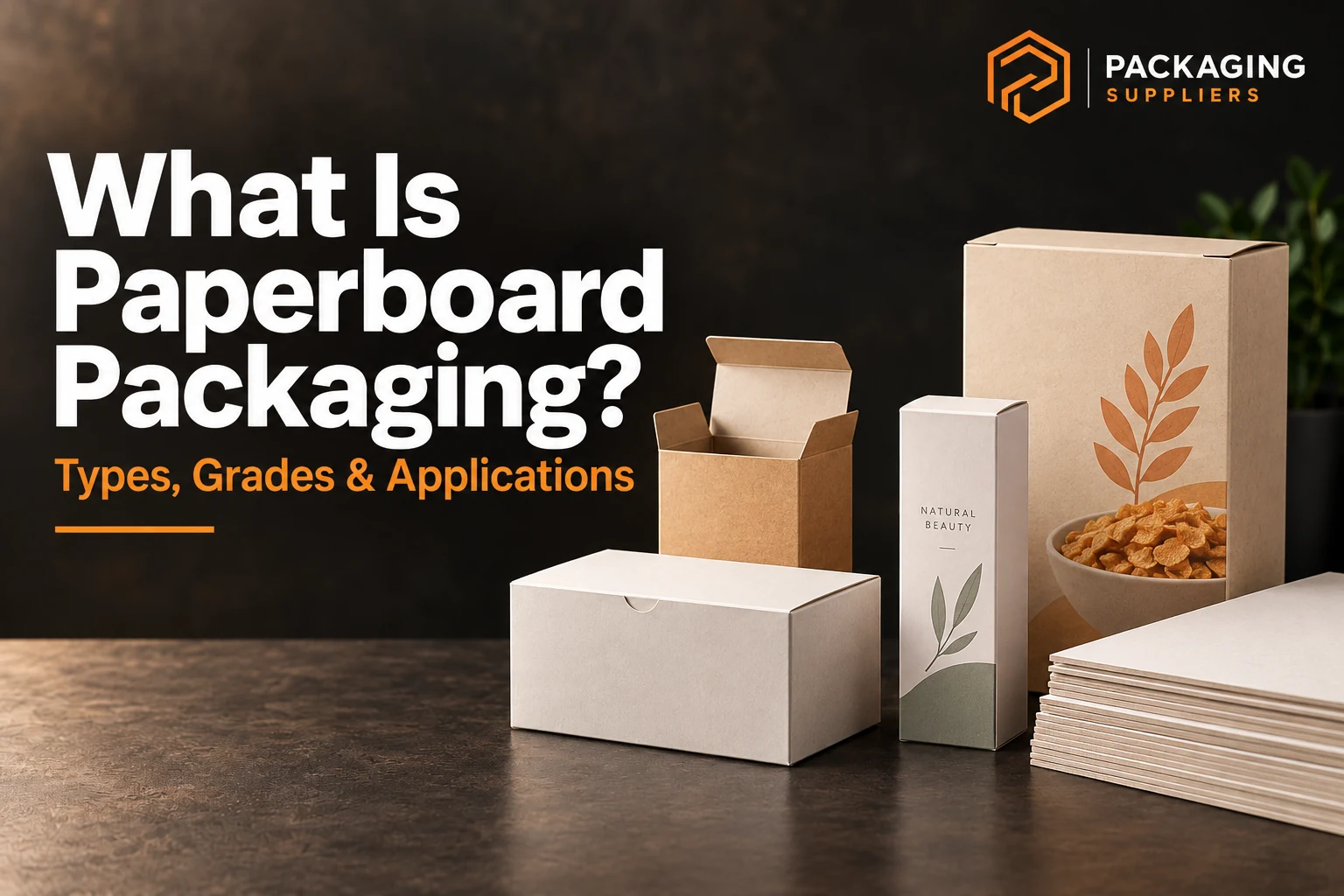
Paperboard packaging uses a relatively thick, stiff paper-based sheet that can be printed, scored, folded, die-cut and glued into cartons, sleeves, trays, cards, cups and other structures. Unlike corrugated fiberboard, ordinary paperboard does not contain a fluted medium between linerboards. Its performance comes mainly from fiber furnish, ply construction, grammage, caliper, density, stiffness, coating and converting quality.
Paperboard is especially common in consumer-facing packaging because it provides a smooth print surface and precise folds while shipping efficiently as flat blanks. It can serve as primary or secondary packaging depending on the product and structure—for example, a dry-food carton may hold a bagged product as a secondary pack, while a paperboard cup can be the primary package.
For the broader comparison across paper, plastic, glass, metal, wood and other material families, see Types of Packaging Materials.
Paperboard packaging at a glance
| Feature | What it means for packaging |
| Structure | Solid or multi-ply paper-based sheet; normally no corrugated flute. |
| Key specifications | Grade/furnish, grammage, caliper, stiffness, coating, surface, grain direction, moisture and converting tolerances. |
| Strength profile | Good panel stiffness and foldability for light-to-medium consumer packs; not a direct substitute for a corrugated shipping case. |
| Printing | Excellent surface for offset, flexo, digital printing, foil, embossing and coatings depending on grade. |
| Typical uses | Folding cartons, sleeves, food and beverage carriers, pharmaceutical cartons, cosmetics, frozen food and retail packaging. |
How paperboard differs from paper and corrugated board
Paper and paperboard overlap in commercial terminology, so a single thickness threshold is not a reliable global definition. In packaging, “paperboard” generally refers to a thicker, stiffer sheet engineered for carton conversion, while papers are more often used for wraps, bags, labels and flexible structures.
Corrugated fiberboard is different because it creates a sandwich structure from flat linerboard and a fluted corrugating medium. The flute produces section thickness, cushioning and edgewise compression performance. A thin solid paperboard carton and a corrugated mailer can both be fiber-based, but they are engineered and tested differently.
For the structural details of linerboard, medium, wall construction and flute profiles, see our corrugated packaging guide.
The main paperboard grades
Grade terminology varies by region and manufacturer, but several families appear repeatedly in folding-carton specifications. The Paperboard Packaging Council lists virgin and recycled board types including SBS, SUS/CUK, FBB, CRB and others. Buyers should still use the supplier’s technical data sheet because the same family name can cover multiple calipers, coatings and performance levels.
| Grade | Typical construction / appearance | Common uses and strengths |
| SBS — Solid Bleached Sulfate | Bleached virgin chemical pulp; usually white throughout and often coated | Premium graphics, cosmetics, healthcare, food, frozen food and high-cleanliness applications |
| CUK / SUS — Coated Unbleached Kraft / Solid Unbleached Sulfate | Strong unbleached kraft-based furnish with natural brown reverse; coated top side where specified | Beverage carriers, frozen/refrigerated food, hardware and packs needing tear/puncture strength |
| FBB — Folding Boxboard | Multi-ply board often using mechanical/CTMP middle layers with bleached outer plies | Lightweight stiffness, confectionery, beauty, pharmaceuticals, food and general retail cartons |
| CRB — Coated Recycled Board | Predominantly recycled-fiber base with a coated print side; back color varies | Dry food, household goods, multipacks and price-sensitive folding cartons |
| URB / chip / uncoated recycled board | Recycled fiber, generally uncoated and less graphics-focused | Set-up boxes, partitions, backing board and internal components |
For current industry examples of these families, see the Paperboard Packaging Council overview and Graphic Packaging paperboard materials guide.
Grammage, caliper and stiffness are not the same thing
Grammage measures mass per unit area. In U.S. paperboard purchasing, you will also see basis weight in pounds and caliper in points (pt). One point equals 0.001 inch, so an “18 pt SBS” board has a nominal caliper of about 0.018 inch before converting tolerances are considered. Basis-weight conventions can vary by grade and mill; TAPPI T 410 defines the U.S. basis-weight approach, while TAPPI T 411 covers caliper measurement.
Do not treat 18 pt, a basis-weight value and a GSM value as three interchangeable ways to state strength. Caliper is thickness; basis weight/GSM is mass per area; stiffness depends on the board furnish, density, ply construction, moisture and grain direction as well as thickness.
This is why “350 GSM,” “18 pt” or a basis-weight number alone is not a complete carton specification. Two boards with similar mass or caliper can have different bending stiffness, fold performance, surface, tear strength and runnability. Request the mill/grade name and technical limits, then validate the converted carton.
Grain direction matters in folding cartons
Paperboard properties are directional because fibers tend to align during papermaking. Grain direction affects bending stiffness, fold resistance, curling and carton erection. Carton designers normally orient the blank so critical scores, panels and machine-running direction work with the board rather than against it. This should be fixed in the dieline and purchase specification.
Coatings, barriers and surface treatments
Clay or pigment coatings can improve smoothness, whiteness and print quality. Functional coatings or laminations may add grease resistance, water resistance, heat sealability, oxygen or aroma control. Windows, foil, metallization and polymer layers can extend performance further.
Those additions also change recovery and compliance. If a carton needs direct food contact, freezer performance or a recyclable claim, evaluate the exact coated and converted structure—not the base paperboard in isolation.
Common paperboard packaging formats
- Straight-tuck, reverse-tuck and auto-lock folding cartons.
- Sleeves around trays, tubs, jars, cans or other primary packs.
- Beverage and multipack carriers engineered for wet and dry handling.
- Pharmaceutical and healthcare cartons with tamper evidence, coding and leaflet systems.
- Cosmetic and fragrance cartons with foil, embossing, windows and high-fidelity graphics.
- Frozen and chilled food cartons using grades/coatings designed for moisture and temperature exposure.
- Paperboard cups, tubs, trays and food-service structures where the board and barrier system are suitable for contact.
- Rigid/set-up boxes that use thicker board wrapped with printed paper, although these are manufactured differently from ordinary folding cartons.
Benefits of paperboard packaging
Excellent print and finishing potential
Smooth coated paperboard supports fine text, photography, color control, foil, embossing and specialty finishes. That makes it effective where the pack is part of the retail brand experience.
Efficient flat shipping and high-speed converting
Folding cartons are normally shipped as flat glued blanks and erected close to filling, reducing inbound and warehouse cube compared with pre-erected rigid containers. Production economics depend on run length, tooling, print method and carton complexity.
Useful stiffness without corrugated bulk
Paperboard can create defined panels, corners and closures at lower caliper than many corrugated structures. This is useful for shelf packs and grouped retail products where parcel-level cushioning is not the main requirement.
Limitations and failure modes
- Ordinary paperboard has limited cushioning compared with fluted corrugated structures.
- Moisture can reduce stiffness and dimensional stability; frozen, chilled or wet environments need verified grades and coatings.
- Heavy products, long stacking periods or parcel networks may require corrugated, inserts or a separate shipper.
- Deep score cracking, fiber tear, delamination, curl and poor glue adhesion can occur if board and converting settings are mismatched.
- High-end coatings, windows, foil or laminations can affect recovery and environmental claims.
- A beautiful carton cannot compensate for an incompatible primary container, weak closure or under-designed shipping case.
Food, pharmaceutical and cosmetic packaging
For regulated contact applications, suppliers should document the exact paperboard, coating, ink, adhesive and conditions of use. In the U.S., food-contact materials are regulated by the FDA; see its Food Ingredients & Packaging resources. Pharmaceutical and cosmetic packs may also require migration, extractables/leachables, tamper-evidence or market-specific labeling controls depending on the product.
Paperboard recycling and environmental claims
Many paperboard formats enter established paper-recovery streams, but the complete pack determines practical recyclability. Wet-strength chemistry, plastic layers, foil, windows, adhesives, heavy food residue and small component size can affect collection and mill acceptance.
AF&PA reported a 2025 U.S. paper recycling rate of 61–65%, but a national material rate should not be used to claim that every individual carton is recyclable. AF&PA 2025 recycling rates The FTC Green Guides also require environmental claims to be truthful and appropriately qualified for access and conditions.
How to choose a paperboard grade
- Define the product, filled weight, dimensions, shelf life and primary-container support.
- Identify storage and use conditions: dry, chilled, frozen, humid, greasy, hot-fill or other exposure.
- Set structural requirements: U.S. caliper in points (pt) where used, basis weight/GSM, panel stiffness, tear, hanger strength, carrier performance and opening/closing behavior.
- Define graphics and finishing: whiteness, smoothness, color targets, foil, embossing, varnish, window and barcode requirements.
- Map the converting process: grain direction, scoring, die cutting, folding, gluing, filling speed and erection method.
- Confirm contact and regulatory documentation for food, pharma, cosmetics or other regulated goods.
- Prototype the carton in production-representative board and test the complete packed system.
- Compare total system cost, including tooling, damage, packing labor, storage and shipping—not only board price per ton.
Paperboard vs corrugated packaging
Choose paperboard when shelf presentation, fine print, compact caliper and precise folds dominate. Choose corrugated when shipping compression, cushioning, pallet stacking or parcel protection dominate. Microflute and litho-laminated corrugated can sit between the two, giving more structural protection while maintaining strong graphics.
See the detailed comparison in Paperboard vs Corrugated Packaging.
Paperboard packaging from Packaging Suppliers
Packaging Suppliers manufactures paperboard cartons and related converted formats within our production scope and can identify an approved production partner when a specialized operation sits outside it. U.S. buyers can specify board grade, caliper in points, basis weight where applicable, dimensions, finish and functional requirements. Request a quote for the controlled specification and a sample when fit, print or finish needs sign-off.
Frequently asked questions
Is paperboard the same as cardboard?
“Cardboard” is an informal umbrella term. In professional packaging, paperboard usually means a solid thick sheet used for cartons, while corrugated fiberboard contains a fluted medium between linerboards.
What is SBS paperboard?
SBS means solid bleached sulfate. It is a bleached virgin-fiber paperboard family valued for whiteness, cleanliness, strength and high-quality printing.
What is the difference between CUK and SUS?
CUK means coated unbleached kraft and SUS means solid unbleached sulfate. The terms are used for closely related unbleached kraft-based paperboard families; exact construction and coating should be confirmed with the mill data sheet.
Is higher GSM paperboard always stronger?
No. Strength and stiffness depend on caliper, density, furnish, ply design, grain direction, moisture and converting quality as well as grammage.
Can paperboard be used for shipping?
It can be used for light or supported applications, but demanding parcel, pallet or freight distribution often needs corrugated or another transport package around the retail carton.
Is paperboard recyclable?
Many clean fiber-based cartons are compatible with paper recycling, but coatings, plastic layers, foil, windows, adhesives, residue and local acceptance determine the finished pack’s practical recyclability.
Sources and standards
References used in the article: