
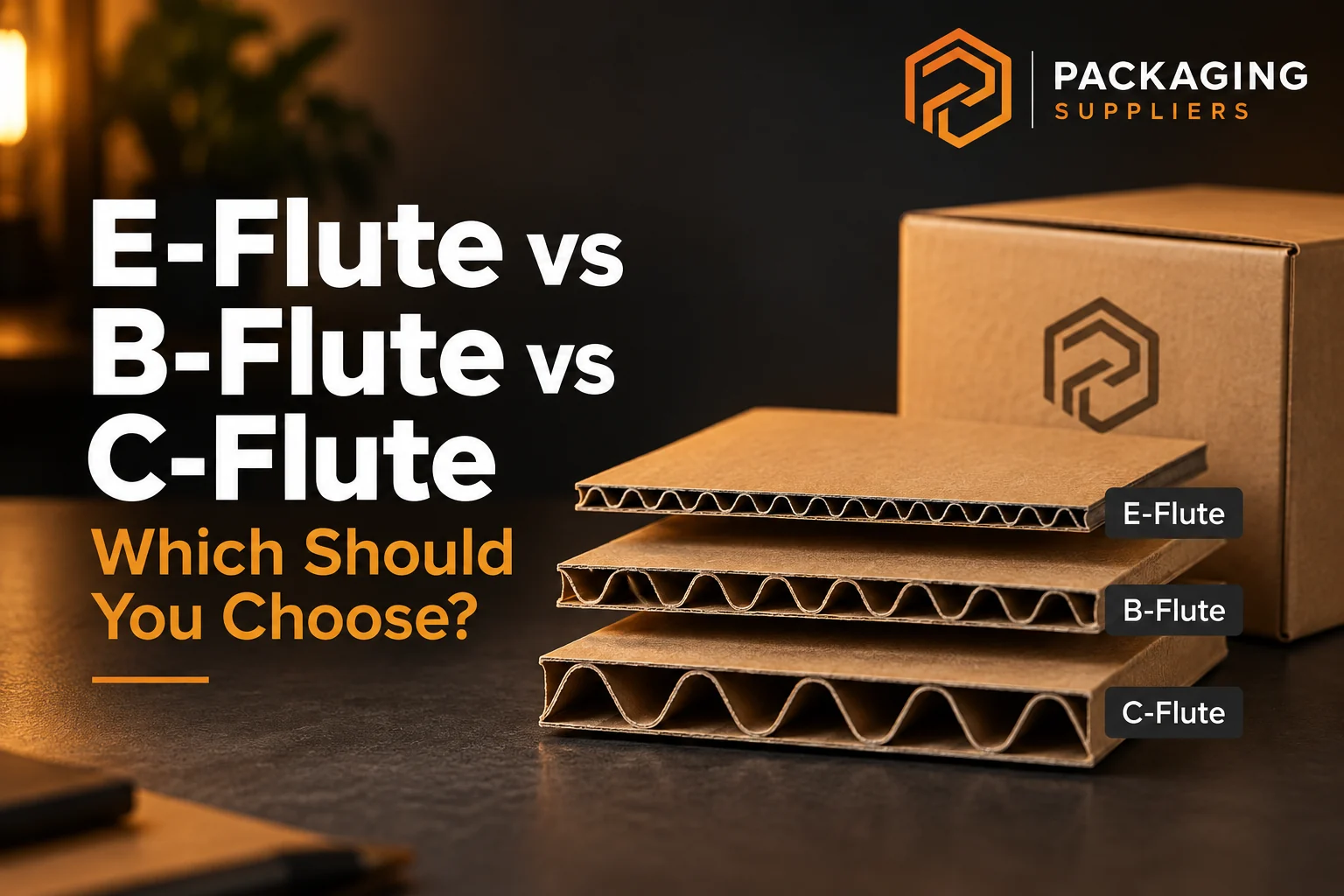
E, B and C are corrugated flute profiles: they describe the approximate geometry and spacing of the fluted paper medium, not a finished-box strength rating. E flute is a thin microflute that favors compact structures and a smoother print surface; B flute offers a useful balance of panel rigidity, flat-crush resistance and converting; C flute is a larger general-purpose profile with more section depth and cushioning.
Do not choose a flute letter by product weight alone. Two boxes with the same flute can perform very differently because liner and medium properties, ECT or burst rating, box dimensions, style, print coverage, die-cuts, joint quality, humidity, pallet pattern and the contents all affect performance.
For the full anatomy of liners, medium, wall construction, ECT and BCT, start with What Is Corrugated Packaging?.
E vs B vs C flute at a glance
| Factor | E flute | B flute | C flute |
| Profile | Thin microflute | Lower-profile conventional flute | Medium-to-tall general-purpose flute |
| Approx. flutes per foot* | About 90 | About 47 | About 38 |
| Surface/graphics | Smoothest of the three; compact caliper helps retail presentation | Good surface with strong die-cut and crease behavior | Good for shipping graphics; surface is less fine than E/B |
| Cushioning | Lower profile; limited cushioning compared with larger flutes | Moderate | Higher profile generally provides more cushioning |
| Flat-crush behavior | Dense flute spacing can support a smooth panel | Often selected where face crush and die-cutting matter | More open/larger profile; application depends on board design |
| Typical starting uses | Retail packs, printed mailers, small cartons, displays | Die-cut boxes, displays, canned goods, mailers, general shipping | General shipping cases, e-commerce shippers, products needing more cushion |
| Important caveat | Flute letter does not define ECT or box compression strength | Flute letter does not define ECT or box compression strength | Flute letter does not define ECT or box compression strength |
*Fibre Box Association gives approximately 90 flutes/ft for E, 47 for B and 38 for C, while also noting that profiles and measurements vary across corrugators. Supplier specifications and approved samples control the actual purchase.
What the flute actually does
Corrugated board uses a fluted medium bonded to flat linerboards. The Fibre Box Association explains that the arches keep the liners separated, increase bending rigidity, help carry vertical load and provide cushioning. Larger flute profiles generally provide more cushioning and vertical compression potential, while smaller flutes generally provide a smoother surface for graphics and compact package geometry.
Those are tendencies, not universal rankings. A flute profile is one design variable inside a board combination. Paper properties, basis weights, bonding, caliper retention and manufacturing quality can shift the outcome significantly.
E flute: compact, smooth and print-friendly
E flute is a microflute with many arches per unit length. Its relatively thin board profile can produce crisp folds, controlled package dimensions and a smoother exterior surface than larger flutes. That makes it useful for retail-ready cartons, premium mailers, displays, small electronics, cosmetics and other applications where graphics and compactness matter.
E flute is not automatically “weak.” A well-designed E-flute board can achieve substantial edge-crush performance, but its thinner section provides less geometric cushioning than larger flutes. For fragile or heavy products, the designer should validate impact and compression rather than relying on appearance or an assumed weight limit.
B flute: panel rigidity and converting balance
B flute uses a denser, lower profile than C flute. It is widely used for die-cut cases, trays, displays, canned goods and shipping formats that benefit from good flat-crush resistance and clean converting. The profile can provide a useful balance between structural performance and print surface without the extra caliper of C flute.
B flute is often a strong starting point when the box includes cut-outs, display features, complex folds or relatively shallow dimensions. However, large hand holes and display windows still remove load-bearing material and can reduce compression strength regardless of flute.
C flute: general-purpose cushioning and section depth
C flute is a widely used general-purpose profile for shipping cases. Its greater section depth than B or E can improve cushioning and bending stiffness for many box designs. It is commonly found in regular slotted containers, e-commerce shippers and distribution cases where transport protection is more important than minimum package thickness.
C flute should not be selected merely because it looks thicker. A lower-grade C-flute board can underperform a properly engineered B-flute board for a specific box. The finished-box requirement must control the decision.
Flute letter is not a strength grade
- ECT: Edge Crush Test measures edgewise compression resistance of a board specimen. It is an important input for stacking-related performance, but it is not the compression strength of a finished box.
- Burst strength: Burst testing measures resistance to rupture under hydraulic pressure. It describes a different board property from ECT, so the two values should not be treated as direct substitutes without an appropriate box specification.
- BCT: Box Compression Test measures the compression behavior of a finished box under defined test conditions. Box perimeter, depth, style, score quality, slots, hand holes, manufacturer’s joint and the product itself can change the result even when the board ECT is the same.
Why flute dimensions on the internet often disagree
Published charts frequently show one thickness and one flute count for each letter. In practice, corrugator roll geometry, paper caliper, take-up factor, adhesive and measurement method create legitimate variation. Fibre Box Association explicitly notes variation within a flute designation. Treat generic thickness values as approximate reference points only; approve the supplier’s board construction, caliper range and sample when fit is critical.
Printing and finishing differences
E flute generally gives the smoothest surface of these three for fine graphics. B flute also prints well and handles many die-cut display structures. C flute works well for flexographic shipping graphics and can support higher-end print through preprint, digital methods or litho-lamination. Print quality is also affected by liner surface, ink system, plate, press, flute crush and artwork—not just flute letter.
Cushioning, fit and internal dimensions
A larger flute creates more thickness between linerboards, which can increase cushioning but also changes internal space. A product fitted tightly into an E-flute mailer may not fit the same dieline converted to C flute. Dimensions should therefore be specified as internal or external explicitly, and physical samples should be approved when inserts, bottles or close tolerances are involved.
When double wall is a better answer
If single-wall board cannot meet the required stiffness, puncture resistance or compression performance, a double-wall structure may be more appropriate. Common combinations include BC, EB and other flute pairs. The purpose is not simply to make the board thicker; combining profiles can balance cushioning, panel rigidity, converting and surface quality.
A double-wall box is still not automatically stronger than every single-wall alternative. Board grade, box design and manufacturing quality remain part of the specification.
Which flute should you choose?
| Requirement | Useful starting point | What to verify before approval |
| Premium printed retail mailer | E flute | Drop/puncture needs, score cracking, print method and product fit. |
| Die-cut display or tray | B flute | Cut-outs, flat crush, stacking, shelf geometry and print. |
| General shipping case | C flute | ECT/burst requirement, BCT target, humidity, pallet pattern and distribution. |
| Cans or self-supporting products | B flute often works well | Panel stiffness, partitioning, pallet load and case dimensions. |
| Fragile item needing more cushion | C flute or engineered insert system | Drop/vibration performance and whether cushioning should come from the box or an insert. |
| Heavy/export load | Double wall may be appropriate | Complete board grade, BCT, handling, climate, palletization and route. |
| Very compact retail pack | E or another microflute | Caliper, crease/fold quality and graphics. |
A requirements-led flute selection workflow
- Record product dimensions, packed mass, fragility, center of gravity and whether the contents add structural support.
- Choose the box style and internal arrangement before fixing the flute. Partitions, inserts and headspace change load paths.
- Map the distribution route: parcel, palletized freight, retail display, cold chain, export storage and expected humidity.
- Set measurable board and box requirements such as ECT, burst, caliper range or finished-box compression where relevant.
- Use flute profile to refine cushioning, surface quality, thickness and converting after the core performance need is clear.
- Approve production-representative samples with the intended print, scores, joint, openings and inserts.
- Test the filled packaging system under the expected distribution conditions before scaling.
ASTM D4169-23e1 is one commonly referenced framework for performance testing of shipping containers and systems; the appropriate test schedule and assurance level should match the actual distribution system.
Common flute-selection mistakes
- Choosing C flute because “thicker means stronger” without defining the strength requirement.
- Assigning universal product-weight limits to E, B or C flute.
- Comparing flute profiles without keeping liner/medium grades and board tests consistent.
- Ignoring humidity, pallet overhang, long-term stacking creep or cold-chain condensation.
- Using a generic internet caliper chart as a manufacturing tolerance.
- Approving an empty sample when the packed product changes box compression or drop behavior.
Manufacture the Right Corrugated Flute Structure
Packaging Suppliers manufactures corrugated packaging in-house where the required board construction and converting processes fall within our production capabilities. For specialized materials, flute combinations, printing, finishing, or converting requirements outside that scope, we can coordinate with approved production partners.
To develop the right corrugated structure, define the box style, inside dimensions, quantity, flute or board construction, required strength or performance, product weight and contents, printing and finishing requirements, and expected storage, stacking, handling, and shipping conditions. If you’re unsure which flute or board specification is appropriate, provide the application and performance requirements so our packaging team can review the options.
Ready for a corrugated packaging quote? Send us your box style, dimensions, quantity, product weight, contents, shipping route, print requirements, and any required board-performance targets such as ECT or burst strength. Include artwork or an existing box specification if available. Request a physical sample or prototype when fit, print quality, stacking, or pack-out needs to be approved before production.
Frequently asked questions
Is C flute stronger than B flute?
Not automatically. C has a larger profile and often provides more cushioning and section depth, while B has a denser profile and strong flat-crush/converting characteristics. Final strength depends on the complete board and box design.
Is E flute suitable for shipping?
Yes, for many lightweight or well-supported products when the board grade, box design and distribution tests are appropriate. It should not be accepted or rejected based on flute letter alone.
Which flute prints best?
E flute generally offers the smoothest surface among E, B and C, followed by B. High-quality printing is still possible on C through the right liner and print process.
What is the difference between ECT and flute type?
Flute type describes geometry. ECT measures edgewise compression resistance of a board specimen. Different E-, B- or C-flute constructions can be made to different ECT levels.
What are BC and EB flute?
They are double-wall combinations using two fluted media with three linerboards. BC tends to provide substantial section depth for demanding shipping; EB can combine a smoother surface with added structural performance.
Which flute is best for e-commerce boxes?
There is no universal best flute. E can suit compact printed mailers, B can suit many die-cut parcel boxes, and C can suit general shipping cases. Product weight, fragility, box size and carrier environment decide the specification.
Sources and standards
References used in the article: