
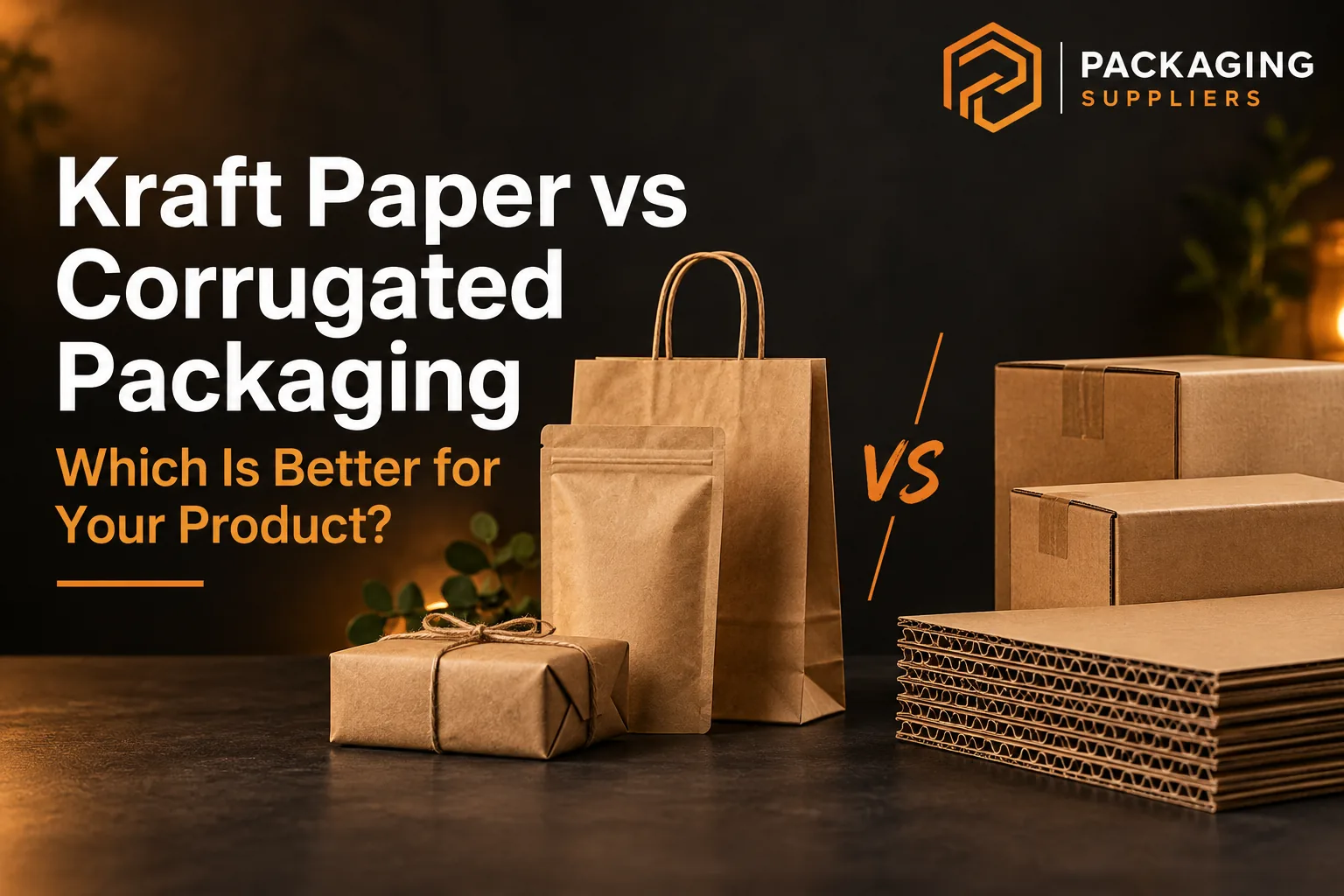
Kraft paper is usually the better fit for wraps, bags, sacks, interleaving and light protective paper. Corrugated packaging is usually the better fit when the package must form a rigid box, resist stacking loads, provide built-in cushioning or survive parcel and freight distribution.
But “kraft vs corrugated” is not a perfect material-to-material comparison. Kraft describes a paper or fiber furnish; corrugated describes a structure made from flat linerboards and a fluted medium. Those linerboards may themselves be kraft linerboard. The practical decision is therefore between a flexible kraft-paper format and an engineered corrugated-board format for a specific product risk.
If you need the definitions first, read What Is Kraft Paper Packaging? and What Is Corrugated Packaging?.
Quick comparison
| Decision factor | Kraft paper | Corrugated packaging |
| Basic structure | Single paper web/sheet or multi-ply sack; flexible | Linerboard + fluted medium; single-face, single-wall, double-wall or triple-wall |
| Best at | Wrapping, bagging, interleaving, void fill, surface protection | Rigid cases, stacking, cushioning, shipping, displays and inserts |
| Strength language | Grammage, tensile, tear, burst, elongation, wet strength, porosity | Flute/wall construction, ECT, burst, BCT, caliper and finished-box tests |
| Cushioning | Limited unless crumpled, layered or engineered into a sack | Flutes create inherent separation and cushioning |
| Storage before use | Compact rolls or flat sheets | Flat box blanks/sheets; generally bulkier than paper rolls |
| Print surface | Natural brown or white/bleached; smoothness varies | Direct flexo/digital or higher-end preprint/litho-laminate options |
| Moisture | Untreated paper is moisture-sensitive | Paper structure is also moisture-sensitive; coatings/treatments can improve performance |
The structural difference matters more than the color
Kraft paper gets its useful strength from the fiber furnish and paper properties. Corrugated board adds geometry: the fluted medium separates the liners and creates bending stiffness, compression resistance and cushioning. That is why a relatively lightweight corrugated case can support stacking loads that a flat paper wrap cannot.
The Fibre Box Association describes corrugated fiberboard as linerboard bonded to a fluted medium; see What Is Corrugated? for the construction details.
Strength: tensile and tear vs compression and box performance
For kraft paper, U.S. buyers may specify basis weight in pounds (for example, “40 lb kraft”) alongside or instead of GSM, plus tensile strength, tear, burst, elongation, wet strength and porosity. For corrugated cases, U.S. specifications commonly use ECT in lb/in, burst strength, flute/wall construction, box dimensions and—where needed—finished-box compression testing. These measures describe different systems and should not be converted into one another as if they were equivalent strength ratings.
Do not compare a kraft-paper basis weight or GSM directly with a corrugated ECT value. One describes paper mass per area; the other measures edgewise compression resistance of combined corrugated board. The decision should be based on the package function, not on which number looks larger.
Protection and cushioning
Corrugated usually has the advantage for fragile or heavy products because the flutes separate the liners and absorb some impact while the panels provide rigidity. It can also be die-cut into fitted inserts, partitions and pads.
Kraft paper works well for surface protection, light abrasion control, interleaving, wrapping and crumpled void fill. It can be an efficient choice when the product is already rigid and does not need a load-bearing outer box. For highly fragile goods, kraft void fill should be validated rather than assumed to replace engineered cushioning.
Printing and presentation
Natural kraft paper gives a brown substrate that can support simple branding but changes ink color and contrast. Bleached or coated kraft improves brightness. Corrugated can be directly flexo or digitally printed, or combined with preprint and litho-laminated facings for more detailed graphics. The best print route depends on run length, flute profile, substrate smoothness and brand expectations.
Moisture and barrier performance
Neither ordinary kraft paper nor standard corrugated board should be described as waterproof. Both are fiber-based and respond to humidity and liquid water. Sizing, wet-strength chemistry, wax alternatives, polymer or dispersion coatings and laminations can improve performance, but the complete treated structure must be validated for repulpability, food contact and environmental claims where relevant.
For water absorptiveness of paper and board, the current ISO Cobb method is ISO 535:2023.
Cost: compare the complete packaging system
A roll of kraft paper may have a lower component cost than a converted corrugated box, but that does not prove it is the lower-cost packaging system. Corrugated may reduce damage, eliminate extra wraps, improve stacking or automate packing. Conversely, a corrugated case can be unnecessary material for a low-risk product that only needs a bag or wrap.
Compare landed cost per protected product: material, conversion, tooling, packing labor, storage, shipping cube, damage, returns and disposal. Prices also vary with fiber markets, coatings, print, order volume, dimensions and supplier location, so avoid fixed “kraft is cheaper” rules.
Recycling and environmental considerations
Both can participate in paper-recycling systems when designed compatibly, but recyclability belongs to the complete pack. Heavy coatings, laminates, labels, tapes, food residue and wet-strength treatments may change mill acceptance. AF&PA reported 2025 U.S. recycling rates of 61–65% for paper and 70–75% for cardboard. AF&PA 2025 recycling rates
Those national rates describe broad paper/cardboard recovery, not automatic local acceptance of a specific package. U.S. environmental claims should still be qualified for the finished structure and the market where it is sold.
Which should you choose?
Start with the job the package must do. The U.S. examples below show where each format is usually the stronger starting point and which specification language buyers commonly use.
| Product | Starting point | What to put in the specification |
| Apparel, tissue wrap or product interleaving | Kraft paper | Often bought by U.S. basis weight in lb and sheet/roll size; structural box strength is usually unnecessary. |
| Retail or takeaway paper bag | Kraft paper | Specify basis weight, dimensions, handle/closure, print and any grease/wet-strength requirement. |
| E-commerce parcel mailer | Corrugated | Specify inside dimensions, box style, flute/board performance and print; RSC or die-cut styles are common U.S. terms. |
| Glass bottles or jars in transit | Corrugated + partitions | The outer case provides stacking and separation; kraft paper may still be used as wrap or void fill. |
| Metal parts needing corrosion protection | Treated kraft + corrugated outer case | VCI or barrier paper can protect surfaces while the corrugated case handles stacking and shipping. |
| Heavy palletized product | Engineered corrugated | Wall construction, ECT/BCT target, pallet pattern and warehouse humidity matter more than flute letter alone. |
A practical decision process
- Define the dominant failure: abrasion, movement, drop, crushing, puncture, moisture, leakage or theft.
- Decide whether the package must be flexible or self-supporting.
- Set the relevant test properties—paper tensile/tear/porosity for kraft formats; ECT/BCT, flute, box design and distribution tests for corrugated.
- Prototype using production-representative stock and the real product.
- Test under realistic humidity, stacking, parcel or freight conditions.
- Compare total cost and material recovery for the complete pack rather than one component.
Need kraft paper or corrugated packaging?
At Packaging Suppliers, We manufactures kraft-paper and corrugated formats within our production capabilities and can identify approved production partners for specialized converting when required. Use kraft when a flexible wrap, bag or paper layer is enough; use corrugated when the pack needs self-supporting geometry, stacking or shipping protection. Request a quote for the selected format and ask for a sample when fit or print needs approval.
Frequently asked questions
Is kraft paper stronger than corrugated cardboard?
They are strong in different ways. Kraft paper can have high tensile and tear strength, while corrugated gains structural stiffness, cushioning and box compression performance from its fluted construction.
Is corrugated made from kraft paper?
Corrugated board is made from containerboard liner and medium. Linerboard may be kraft linerboard, recycled linerboard or another approved containerboard furnish, so some corrugated contains kraft-based components.
Which is better for shipping?
Corrugated is usually the starting point for a self-supporting shipping case, especially for fragile, heavy or stack-loaded products. Kraft paper is often used as inner wrap, void fill or a bag when a rigid shipper is unnecessary.
Which is cheaper?
It depends on the format, dimensions, grade, print, order volume, packing labor and damage risk. Compare total delivered cost per protected product rather than material price alone.
Are kraft and corrugated recyclable?
Many clean fiber-based formats are compatible with paper recycling, but coatings, tapes, labels, residues and local collection/processing determine the practical outcome.
Sources and standards
References used in the article: