
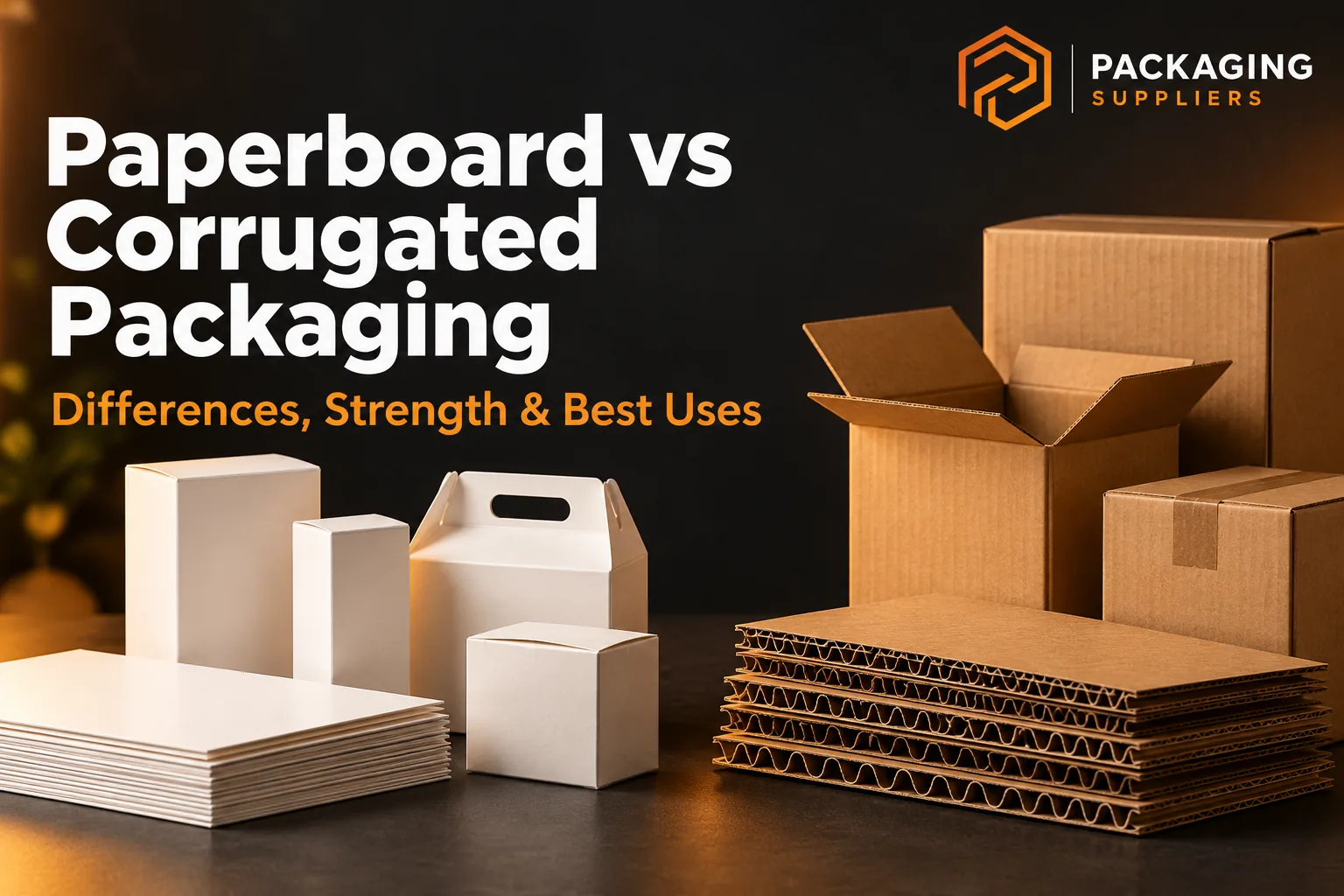
Paperboard is a solid, stiff paper-based sheet commonly converted into folding cartons, sleeves and retail packs. Corrugated packaging is a layered structure made from flat linerboards bonded to one or more fluted paper media. Paperboard is usually chosen for compact retail presentation and fine graphics; corrugated is usually chosen when cushioning, stacking strength and transport protection are more important.
Neither is universally better. Many products use both: a printed paperboard carton as the consumer-facing secondary package and a corrugated master case as tertiary transport packaging. The right choice depends on which failure the package must prevent and where it sits in the packaging system.
For deeper definitions, see What Is Paperboard Packaging? and What Is Corrugated Packaging?.
Paperboard vs corrugated at a glance
| Factor | Paperboard | Corrugated |
| Structure | Solid or multi-ply sheet; no fluted core in ordinary folding carton board | One or more fluted media bonded to linerboards |
| Typical role | Retail cartons, sleeves, multipacks, light primary/secondary packs | Shipping cases, mailers, retail-ready trays, displays, partitions, heavy-duty packs |
| Strength focus | Bending stiffness, tear, score/fold quality, hanger/carrier performance | Edge compression, box compression, burst/puncture, cushioning and stacking |
| Graphics | Excellent fine print and finishing on smooth surfaces | Good to excellent depending on liner, flute and print method; litho-laminate/preprint can be high-end |
| Cushioning | Low unless combined with inserts or structure | Flutes provide built-in separation and cushioning |
| Storage | Flat blanks use little cube | Flat cases/sheets also store efficiently, but greater caliper uses more cube |
| Best use | Shelf presentation and compact consumer packs | Distribution protection and structural shipping packs |
Structure: solid sheet vs fluted sandwich
The practical structural difference is simple: paperboard is a solid sheet that creates a compact folding carton, while corrugated adds a fluted core between liners to create section depth, cushioning and shipping stiffness. For full construction details, use the dedicated paperboard and corrugated guides rather than treating this comparison page as a second definition article.
The Fibre Box Association defines corrugated fiberboard around its liner and medium construction, while the Paperboard Packaging Council describes paperboard formats such as folding cartons and rigid boxes.
Strength: do not compare the wrong numbers
Use the specification language that matches the format. U.S. paperboard quotes often use grade plus caliper in points (for example, 18 pt SBS) and may also state basis weight; corrugated quotes use wall/flute construction plus board-performance values such as ECT or burst. Those numbers are not interchangeable.
A paperboard GSM, lb basis-weight or point-caliper value cannot be converted into a corrugated ECT rating. If shipping strength is the decision driver, compare the finished structures against the same product and distribution requirement instead of comparing substrate numbers.
For paper and board grammage, see ISO 536:2019. For a deeper explanation of ECT and BCT, see our corrugated packaging guide.
Printing and branding
Paperboard usually has the advantage when fine graphics, small type, foil, embossing or premium finishing are central. Smooth coated SBS, FBB or CUK surfaces can reproduce detailed artwork and consistent color well.
Corrugated printing ranges from economical direct flexography to digital, preprint and litho-lamination. Fine microflutes such as E and F can create a flatter surface and a thinner pack than larger flutes, so the visual gap between folding cartons and corrugated has narrowed for e-commerce and retail-ready applications.
Protection and distribution performance
Corrugated generally provides more structural protection per package because the flutes add cushioning, panel thickness and stacking capability. That is important for parcel drops, pallet loads, appliances, glassware and other products exposed to repeated handling.
Paperboard works well when the product or primary container provides much of its own strength and the carton mainly needs presentation, grouping, information and moderate protection. When a paperboard carton enters a demanding carrier network, it often sits inside a corrugated shipping case.
Moisture and temperature exposure
Both materials are fiber-based, so humidity and liquid water can change performance. Paperboard may curl, soften or lose stiffness; corrugated can lose compression capacity as liners and medium take up moisture. Chilled, frozen or wet environments require grades, coatings, adhesives and testing designed for those conditions.
Water absorptiveness can be measured using the current ISO 535:2023 Cobb method for paper and board. Corrugated finished-pack performance should still be evaluated under representative humidity and load conditions.
Cost and logistics
Paperboard can be highly efficient for compact, high-volume folding cartons because blanks ship flat and use relatively little material volume. Corrugated uses more caliper but may prevent damage, replace separate cushioning or allow unit loads to stack safely. Print method, tooling, board grade, dimensions, volume, assembly, labor and freight all change the economics.
Do not assume paperboard is always cheaper or corrugated is always more expensive. The correct comparison is total cost per delivered, saleable product.
Microflute: where the categories overlap
Microflute corrugated—commonly E, F and other fine profiles—can create thin structures with better crush resistance than ordinary folding carton board while still supporting strong graphics. Litho-laminated microflute attaches a printed sheet to corrugated board and is common where a retail package also needs more structural protection.
Microflute is useful when a folding carton feels too weak but a conventional B- or C-flute shipping case is too bulky. It still needs a corrugated specification: flute, liners, medium, caliper, ECT or other performance targets and finished-pack validation.
Which one should you choose?
| Requirement | Better starting point | Reason |
| Premium cosmetics carton | Paperboard (often SBS/FBB) | Fine graphics, crisp folds and finishing |
| Cereal or dry-food folding carton | Paperboard | Efficient retail structure with printable panels |
| Glass jars shipped in cases | Corrugated | Stacking, partitions and shipping protection |
| Subscription/e-commerce mailer | Corrugated or microflute | Rigid self-mailing structure and parcel durability |
| Small electronics retail pack with moderate protection | Paperboard or microflute | Balance of graphics and structure depends on product fragility |
| Heavy industrial product | Corrugated, often heavier wall construction | Compression, puncture and handling performance |
| Retail display tray | Corrugated | Die-cut rigidity and load support at shelf |
A system-level example
Consider a premium skincare bottle. The bottle and pump form the primary package. A printed SBS folding carton provides branding, ingredients and tamper-evidence features as the secondary pack. Twelve cartons are packed into a corrugated master case with a pallet pattern and stretch wrap for tertiary distribution. Choosing “paperboard or corrugated” for the entire product would miss the fact that each level solves a different problem.
See Primary, Secondary and Tertiary Packaging for more examples of how materials move between packaging levels.
Recycling and environmental claims
Both paperboard and corrugated have established fiber-recovery routes, but coatings, foil, windows, laminates, wax alternatives, adhesives and food residue can change practical recyclability. Corrugated recovery statistics should not be applied automatically to a coated folding carton, and broad “eco-friendly” claims should be avoided without a defined basis.
AF&PA reported 2025 U.S. recycling rates of 61–65% for paper and 70–75% for cardboard. AF&PA 2025 recycling rates These national figures should not be applied automatically to a coated or multi-material carton; for U.S. marketing claims, use the FTC Green Guides and the actual local recovery route.
What to put in the RFQ?
- Finished inside dimensions and packed product weight.
- Paperboard grade/caliper in points or corrugated board/flute/ECT requirement, when already known.
- Print process, colors, finish, window/foil/lamination and barcode requirements.
- Quantity per SKU, expected annual volume, packing method and filling-line constraints.
- Distribution route and acceptance test: retail handling, parcel, pallet, humidity or other exposure.
Turn the paperboard-vs-corrugated decision into a production spec
Packaging Suppliers manufactures paperboard and corrugated formats within our production scope and can coordinate approved production partners for specialized processes where needed. Once the format is chosen, lock the board grade or corrugated construction, inside dimensions, print, tolerances and performance requirements. Request a quote against that specification and a sample when structure, graphics or fit needs physical approval.
Frequently asked questions
Is paperboard stronger than corrugated?
Not in a single universal sense. Paperboard can be very stiff and strong for a thin retail carton, while corrugated generally provides more structural compression and cushioning for shipping because of its fluted geometry.
Is paperboard the same as cardboard?
Cardboard is informal. Paperboard usually refers to solid carton board, while corrugated cardboard refers to linerboards plus a fluted medium.
Can paperboard be used for shipping boxes?
For light products and controlled routes, yes, but demanding parcel or pallet distribution often needs corrugated or another transport package.
Which prints better, paperboard or corrugated?
Paperboard generally offers the smoothest surface for fine graphics. Corrugated can still deliver high-quality printing through digital, preprint or litho-laminated methods, especially with fine flutes.
What is microflute packaging?
Microflute is thin corrugated board using fine flute profiles such as E or F. It bridges some of the gap between folding carton presentation and corrugated structural protection.
Which is more recyclable?
That cannot be decided by the category alone. The complete structure, coatings, labels, adhesives, residue and local recycling system determine practical recyclability.
Sources and standards
References used in the article:
- Fibre Box Association — What Is Corrugated?
- Paperboard Packaging Council — What Is Paperboard Packaging?
- ISO 536:2019 — Paper and board — Determination of grammage
- ISO 535:2023 — Paper and board — Determination of water absorptiveness (Cobb method)
- AF&PA — 2025 U.S. Paper and Cardboard Recycling Rates